Stylistic Analysis: we're taking a break from looking at art through the lenses history, geographically and chronologically; today we turn to STYLE and PURPOSE.
Paraphrasing philosopher Berel Lang, Style is not only not a science, it's a version of fiction – a narrative form ... in which one feature is an ingredient in all the others. In other words, to decisively name a style like "Old Kingdom Egyptian" or "Minoan", we'd have to see the feature we're identifying in all of the objects. Nonetheless, looking at stylistic attributes help us hone the tools of observation, finding connections and contrasts that can help build our capacities to see and ask questions. Here's the link to the exercise
Technique
- Was the object or image built up by adding material, or was it created by carving away material?
- What kind of paint or finish was added to the material?
- Does the technique seem methodical or spontaneous? How so?
Color
- What colors are present? How are the colors arranged?
- Do the colors appear saturated or muted?
- Are the colors warm or cool?
- Do the colors complement one another or does one clash with the others?
Texture
- Does the material have a physical texture? How would you describe it? What creates the texture?
- Does the material simulate or imply texture in some way, even if on a flat surface? How so?
Line
- Are contour lines present?
- How would you describe the quality and direction of the lines (for example, heavy or thin, rough or smooth, short or long, horizontal, vertical, or diagonal)?
- How do lines create movement or a sense of direction?
- What are any figures depicted looking at or gesturing towards?
Shape
- Are the figures naturalistic or abstract?
- Are the forms geometric or organic?
- How do shapes repeat throughout the composition?
- For figures, are the proportions distorted, elongated, or idealized?
- What kinds of shapes are formed from the negative space?
(Probably for another day, another analysis: Composition
- How are all the different components of the object or image arranged?
- What do you notice first, and why?
- How does the work lead you through the composition?
- Is the composition symmetrical or asymmetrical? If asymmetrical, is the composition balanced in some way?)
*Questions from UNC-Chapel Hill's writiing center
Counting Containers
I'm tying today's work to containers because I spent an awful lot of time in museums in the last 6 months, and I became overwhelmed by the sheer numbers of 2-3000 year old containers in museums. Why and How?
 |
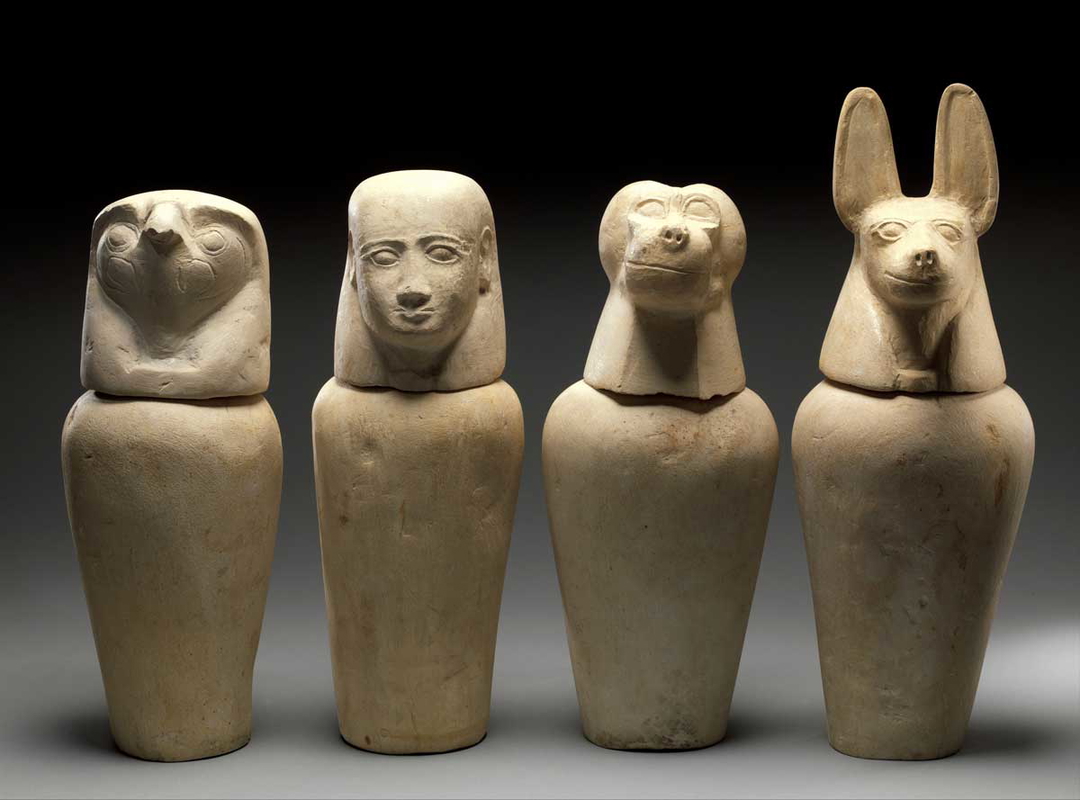
| Canopic Jars, Late Period New Kingdom Egypt, ~650 bce stone |
- Hapi: the baboon-headed god representing the North was protected by the goddess Nephthys and was assigned to the lungs;
- Duamutef: the jackal-headed god representing the East was protected by the goddess Neith and was assigned to the stomach;
- Imseti: the human-headed god representing the South was protected by the goddess Isis and was assigned to the liver;
- Qebehsenuef: the falcon-headed god representing the West was protected by the goddess Serket and was assigned to the intestines"
From wikipedia-- regarding the jars with iconographic heads, particularly those with religious significance from the late period.
"Following the Nineteenth Dynasty canopic jars stylistically were carved to represent the four sons of Horus. Each of Horus's sons, along with a companion goddess, were responsible for protecting a particular organ and represented a cardinal direction:[15]
 |
| Canopic Jars, Ancient Egypt, ~600 bce |
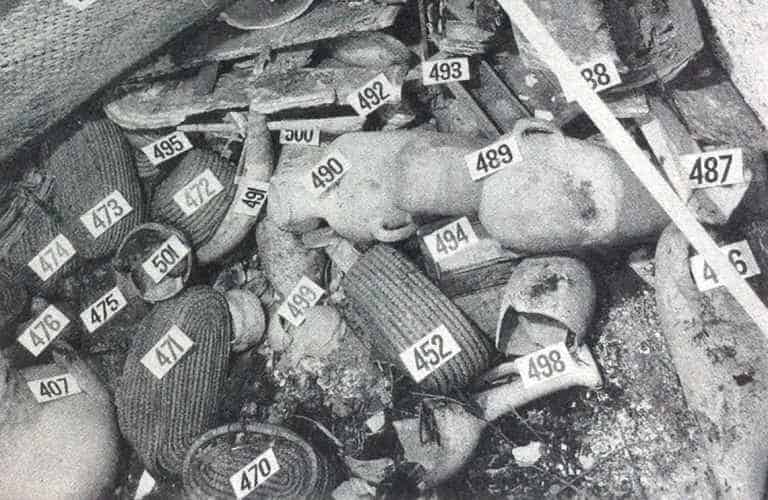 |
| Amphorae in the tomb of Tutankhamun, ~1327 |
 |
| Wine Amphora, ~1500 BCE, Ancient Egypt |
| Vessels in the Etruscan Museum, Rome |
| Wine Amphora, Pompeii, 79 CE, Ancient Rome |

| Villa Giulia, Etruscan Museum, Rome |
| Villa Giulia, |
 |
| Krater from Dipylon Cemetary, 730-735 bce, terra cotta, 43" tall |


Ancestral Puebloan, 900-1150, North American Southwest, Mesa Verde Colorado:
|
| Animal Vase, terra cotta, ~850-1150 CE, Ancestral Puebloan, |
Ancestral Puebloan, North American Southwest, Mesa Verde Colorado:
- Basketmaker III (A.D. 500 - 750)
- Pueblo I (A.D. 750 – 900)
- Pueblo II (A.D. 900 – 1150)
- CLASSIC PUEBLO PERIOD (A.D. 1100 - 1300)/Pueblo III

No comments:
Post a Comment