Visual and Physical Prayers
Tying knots, laying stones, painting letters and otherwise meditating
 |
| Sainte Chapelle, Paris, built in four years under the authority of Louis IX, in 1244. 118 x 56 x 139 ft |


 |
God the Geometer, Bible Moralisé of Blanche of Castile, 1220 ce, 10" x 13" Gothic
|
 |
| The Ancient of Days setting a Compass to the Earth, 1794 |
All maps from Wikipedia

If you're interested in this material, here are some readings that can help you, because this material is not really in the book. Reading choices include Elizabeth Howie’s article on the Apotropaic properties of interlace decoration, the film The Name of the Rose, the Umberto Eco book on which it was based, the animated Secret of Kells. (neither of these films will give you facts, but the websites listed within this website will. .
 CCORDING to Legend, Saint Kevin's mother felt no pains during childbirth, and the snowfall that attended the birth of her son melted in a band around their home. That was in the year 498. God, it appeared, marked Kevin from the very moment of his birth. Legend tells us much about Kevin, though history records very little. From his early days, Kevin was surly with people and kind to animals, and the animals repaid his kindness throughout his life.
 | |
|
Once, Kevin went to the woods to pray and meditate for all of Lent. He stayed in a simple hut, so small that when he flung his arm up in prayer, it went out the window. There, a blackbird landed, mistook Kevin's hand for a nest, and laid an egg in it. Feeling the warm egg, Kevin stood very still for all of lent while the eggs hatched, and hatchlings fledged. Lucky for him, the blackbird fed him.

For many years, Kevin lived in what's known as St. Kevin's bed, a five foot by three foot by seven foot cave. Kevin refused the company of women, but this refusal meant nothing to one Kathleen, who followed him about and tried to seduce him in his rocky bed. Kevin pushed her out of the cave and into the lake, where she drowned.
 |
| St. Kevin's Bed. source |
After many years living in this simple hermitage, Kevin felt that he should return to serve as a priest, teaching all that he had learned. He wished to establish a monastery, but the ruler, King O'Tool, being a pagan, refused to let him. However, King O'Tool's beloved goose grew old and sick. Despairing what to do, he asked Kevin to make the goose young again. Kevin agreed, in exchange for whatever land the goose flew over. Since the elderly goose could not fly, King O'Tool agreed.

Kevin healed the goose,and it took off and flew over all of Glendalough. Kevin gathered workers and begin the project immediately, asking his workers to begin with the first song of the lark, and to work until the sheep went to bed. They used the materials the land provided, stone, resulting in this simple wonder of dry-stack stone architecture.
 |
| St Kevin's Church, near the site of the original small stone cathedral. This building constructed beginning 12th century. |
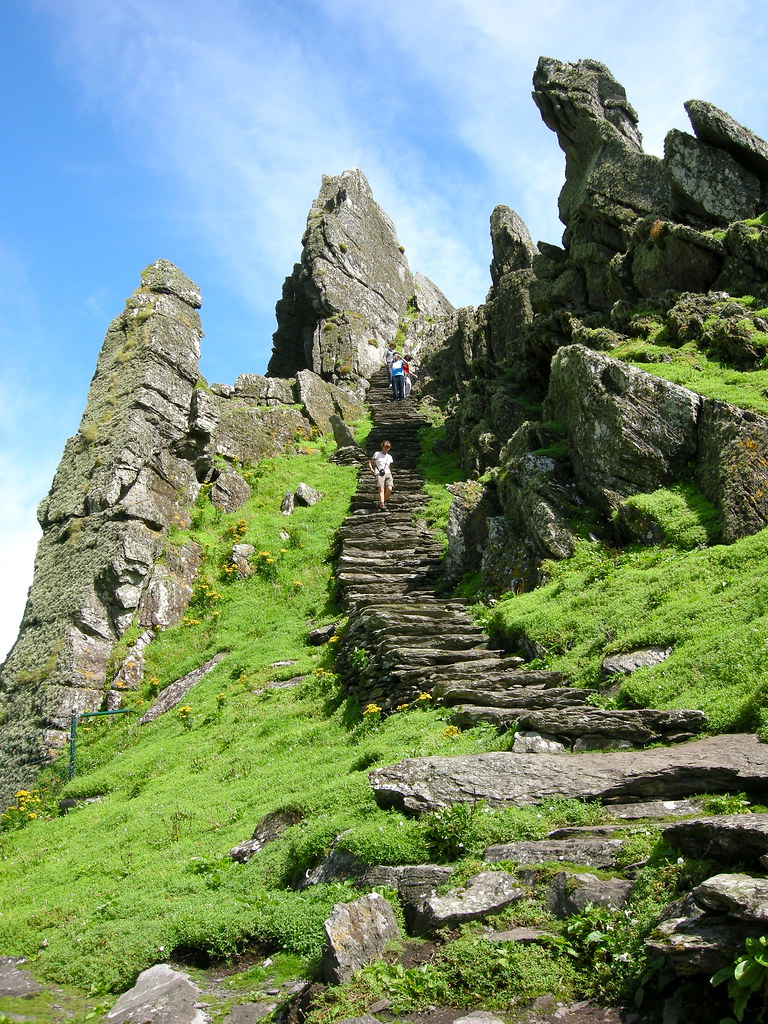
St Kevin's life of asceticism was certainly not unique. You can instantly detect a visual similarity between his church and the monastery at Skellig Michael off the shore of county Derry, in Ireland.

 |
| Image Credit Flickr User Irish Fireside |
 |
| Skellig Michael Stairs seen from above. source. |

About 12 monks and an abbot inhabited this monastery, approachable only by choppy seas, from about the 7th to 12th centuries. They chose a life of isolation, cold, and self-denial as a way to remove obstacles from their connection to God. They built their own dry stack beehive shaped stone huts, and grew what vegetables they could.

In mainland Europe, one of the major ways that monks brought income to the monastery was by making books, illuminated (that is, made brilliant with illustrations), and handwritten (therefore called manuscripts). (by the way. Before books, people wrote on clay, bark, and papyrus, often rolling their writing into scrolls. Romans invented books, which began to replace scrolls during the early days of Christianity, by about 300 ce, people produced books and scrolls in about the same numbers. By 600 ce, books basically replaced scrolls.)
Do any of the places seem familiar?


An Illuminated Manuscript combines handwritten texts with images (painted in precious pigments and metals) that shed light on the meaning of the words and add pleasure, play, and value. The word manuscript combines Latin words manus (hand) and scriptus, (from verb to write). In Europe, monks typically made these books from the point of raising the sheep and goats that gave their skins to make the parchment, to the ruling and hand writing of the texts, to the illuminating with images, to sticking the leaves together, to the binding of the pages in covers made of wood, leather, or precious metals. If the making of these books interests you, you can find a thorough description of the process at the Getty Museum's website, and an interactive walkthrough of their manufacture at the Fitzwilliam Museum site.

unknown artist, author portrait of Jean Miélot writing the Miracles of Our Lady, 15th century
Watching the film The Name of the Rose, starring Sean Connery and based on the book by Umberto Eco, offers a fun way to get to know the physical and some of the practical aspects of monastic life. This clip (dead link-- full film minute 26:40 exterior carvings; 31:10 entering the scriptorium) gives some great images of the exterior of a Romanesque monastery built for the film, and some detail shots filmed at The Abbey Church at Souillac in Périgord, France.
"Compositionally, Eadfrith stacked wine-glass shapes horizontally and vertically against his intricate weave of knots. On closer inspection many of these knots reveal themselves as snake-like creatures curling in and around tubular forms, mouths clamping down on their bodies. Chameleon-like, their bodies change colors: sapphire blue here, verdigris green there, and sandy gold in between. The sanctity of the cross, outlined in red with arms outstretched and pressing against the page edges, stabilizes the background’s gyrating activity and turns the repetitive energy into a meditative force. " from Louisa Woodville, Khan Academy, here.

Carpet Page, Lindisfarne Gospels, Insular Manuscript, 715 ce, 13" x 9.5"(p.428) " The limitation of the page was a perfect foil to the infinity of Celtic patterns" (from catalogue entry by Elizabeth Howie, here.)


Elizabeth Howie also describes the magical powers associated with Insular Manuscripts visible in their design. She writes: "According to Bernard Meehan the Book of Durrow [similar to the Lindisfarne Gospels] is "the earliest surviving fully decorated insular Gospel manuscript," (Meehan, 9.) It is considered to represent a "new, essentially medieval concept of embellishing the sacred text as though with precious jewels and textiles." (Calkins, 31.) It is the first example of a full program of decoration which complements the structure of the text. (Calkins, 36.) Its date of origin is controversial but is believed to be the late 7th century. Its origins have also been the subject of debate, with scholars arguing between Durrow and Northumbria as likely places of origin, with current scholarship leaning toward Durrow. Like the Codex Usserianus Primus and the Cathach of St. Columba, the Book of Durrow had its own shrine that was lost in the late 17th century. In the 17th century, the book was dipped into a trough for sick cattle to drink out of, as it was believed to possess curative powers."
"The Book of Durrow continues the use of diminuendo seen in earlier manuscripts. It also continues the use of interlace decoration. Interlace is thought to have an apotropaic function because of its perceived ability to trap evil." From this catalogue entry.

Chi Rho page of the Book of Kells, late 8th or early 9th c. Scotland. tempera on vellum. (10-4)
Greek Letters Chi Rho Ota (XPI or Chri) Now this is how the birth of Jesus Christ came about..."
In the beginning was the Word, and the Word was with God, and the Word was God.... 14 And the Word was made flesh, and dwelt among us, (and we beheld his glory, the glory as of the only begotten of the Father,) full of grace and truth. John I, KJV.

Lower Cover of the Lindau Gospels, Austria, 775 ce, 13.5 x 11",now in the Pierpoint Morgan Library, New York.
Crucifixion, cover of Lindau Gospels, 870-880 (10-11)
Sutton Hoo Hoard, Chi Rho Page from Book of Kells Saint Faith (Foy) Reliquary Giselbertus, Last Judgement
Author Portrait of John the Evangelist from the Book of Kells, Insular Style Manuscript from ~805 ce, colors on vellum


"typical" text page from Book of Kells, 805 ce
Quoting
Giraldus de Barri, 12th c. author, Hugh Honour and John Fleming write:
“Examine it carefully and you will penetrate to the very shrine of art. You
will make out intricacies so delicate and subtle, so concise and compact, so
full of knots and links, with colors so fresh and vivid, that you might think
all this was the work of an angel, not a man.”

detail from Book of Kells, 805 ce


I see a strong relationship between this:
and this:
What relationships can you see?

KEY WORK! Portrait of Matthew, Gospel Book of Ebbo, 10.5" x 8.8"Carolingian Style, ~830 ce. (10-10)


Mark
 |
| Caravaggio, Inspiration of Matthew, 1602 |

Key Terms: Manuscript, Scriptorium, reliquary, interlace

 |
| Sutton Hoo Burial site |
 |
| Purse Cover, Sutton Hoo Burial, england, 615-625 |


Roman de la Rose,French, tempera on vellum, 1353 (641)
When I the age of 20 had attained –
The age when Love controls a young man’s heart –
As I was wont, one night I went to bed
And soundly slept. But there came a dream
Which much delighted me, it was so sweet
When I the age of 20 had attained –
The age when Love controls a young man’s heart –
As I was wont, one night I went to bed
And soundly slept. But there came a dream
Which much delighted me, it was so sweet

Bayeux Tapestry (10-18), on half of the gallery, likely made in England, 1070's


20' Star wars tapestry
Saint Faith (Foy) Reliquary (10-18),
talk about tedious. Here are a couple of Brian Dettmer's fantastic Book Autopsies, made in the last few years. Dettmer would have made a good monk, I believe.
talk about tedious. Here are a couple of Brian Dettmer's fantastic Book Autopsies, made in the last few years. Dettmer would have made a good monk, I believe.


 |
| Like the Sutton Hoo hoard has visual similarities to the more meditative objects, Machu Picchu looks today similar in some ways to the monastery at Skellig Michael, though the purposes are very different. Most recent dating suggests that Macchu Picchu was occupied from around 1420 to 1530 AD, with construction taking place under two Inca rulers, Pachacutec Inca Yopanqui (1438–1471) and Túpac Inca Yupanqui (1472–1493). |
Extra materials
Insular Manuscripts from betsy towns on Vimeo.
Gothic Architecture from betsy towns on Vimeo.