Key Terms: icon, iconography, iconoclasm, Byzantine, mosaic,

Byzantine Art and Architecture

Berlinghiero, Madonna and Child, 1230
from the Web Gallery of Art, a definition of Byzantine art: The art of the Byzantine Empire, which had its capital in Constantinople (Byzantium), from the 5th century to the fall of Constantinople to the Turks in 1453. Based largely on Roman and Greek art, Byzantine art also absorbed a wide of influences, notable from Syria and Egypt. Byzantine art was essentially a spiritual and religious art, its forms highly stylized, hieratic and unchanging (central images were thought to derive from original portraits). It also served to glorify the emperor. Among its most distinctive products were icons, mosaics, manuscript illuminations, and work in precious metals. The strong influence of the Byzantine style on medieval Italian painting can be seen in the works of Cimabue, Duccio, and Giotto.
A different definition governs the use of byzantine in popular conversation. There, we use byzantine to mean complicated to the point of deceptive or at least confusing. That definition probably comes out of the Renaissance distaste for Byzantine art.
byzantine
a. Of, relating to, or characterized by intrigue; scheming or devious: "a fine hand for Byzantine deals and cozy arrangements" (New York).
b. Highly complicated; intricate and involved: a bill to simplify the byzantine tax structure.
byzantine
a. Of, relating to, or characterized by intrigue; scheming or devious: "a fine hand for Byzantine deals and cozy arrangements" (New York).
b. Highly complicated; intricate and involved: a bill to simplify the byzantine tax structure.
Then, some terms important to understanding Byzantine Art.
Words associated with the Byzantine that you should know.
Icon:
a. An image; a representation.
b. A representation or picture of a sacred or sanctified Christian personage, traditionally used and venerated in the Eastern Church.
Icon:
a. An image; a representation.
b. A representation or picture of a sacred or sanctified Christian personage, traditionally used and venerated in the Eastern Church.
Iconography
a. Pictorial illustration of a subject.
b. The collected representations illustrating a subject.
a. Pictorial illustration of a subject.
b. The collected representations illustrating a subject.
Iconoclasm
1. the practice of destroying images, especially those created for religious veneration.
2. the practice of opposing cherished beliefs or traditional institutions as being founded on error or superstition.
3. the doctrines underlying these practices. — iconoclast, n. — iconoclastic, adj.
Orthodoxy the condition, quality, or practice of conforming, especially in religious belief.
Then, let's get even more confusing, for matters of taste prove fickle. By the late 19th century, the Byzantine Art had swung back into favor, not with all but with many. So much so that William Butler Yeats used the style to express Beauty, Permanence, Imagination, an Ideal of Art, Monument to unageing intellect in his poem "Sailing to Byzantium."
How does architecture achieve meaning? In the case of Byzantine, architects sought to use the church as a metaphor for the ideal christian, plain but perfectly ordered on the outside:

How does architecture achieve meaning? In the case of Byzantine, architects sought to use the church as a metaphor for the ideal christian, plain but perfectly ordered on the outside:
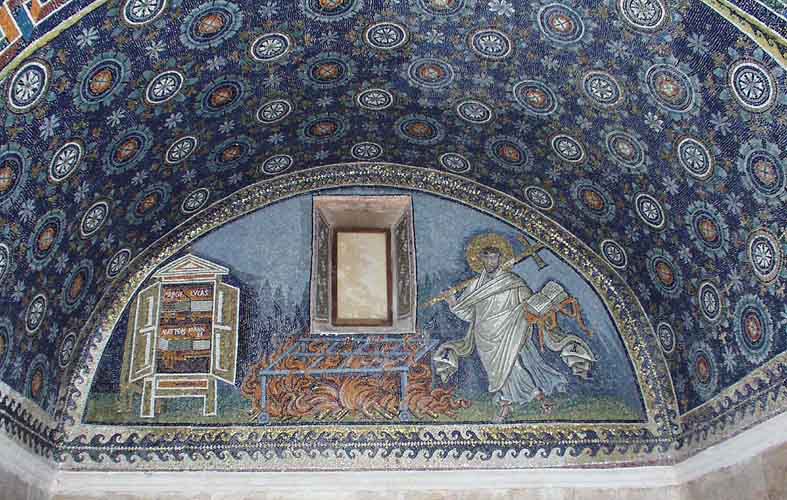
The Mauseleum of Galla Placidia, in Ravenna, 425-450 CE, exemplifies the ideal of Byzantine architecture. Unassuming, yet perfectly detailed on the outside, and on the plan of a cross, and, on the inside:

Ceiling of the Mausoleum of Galla Placidia, Ravenna
dazzling with jewels and gold as the christian soul is supposed to be.

\
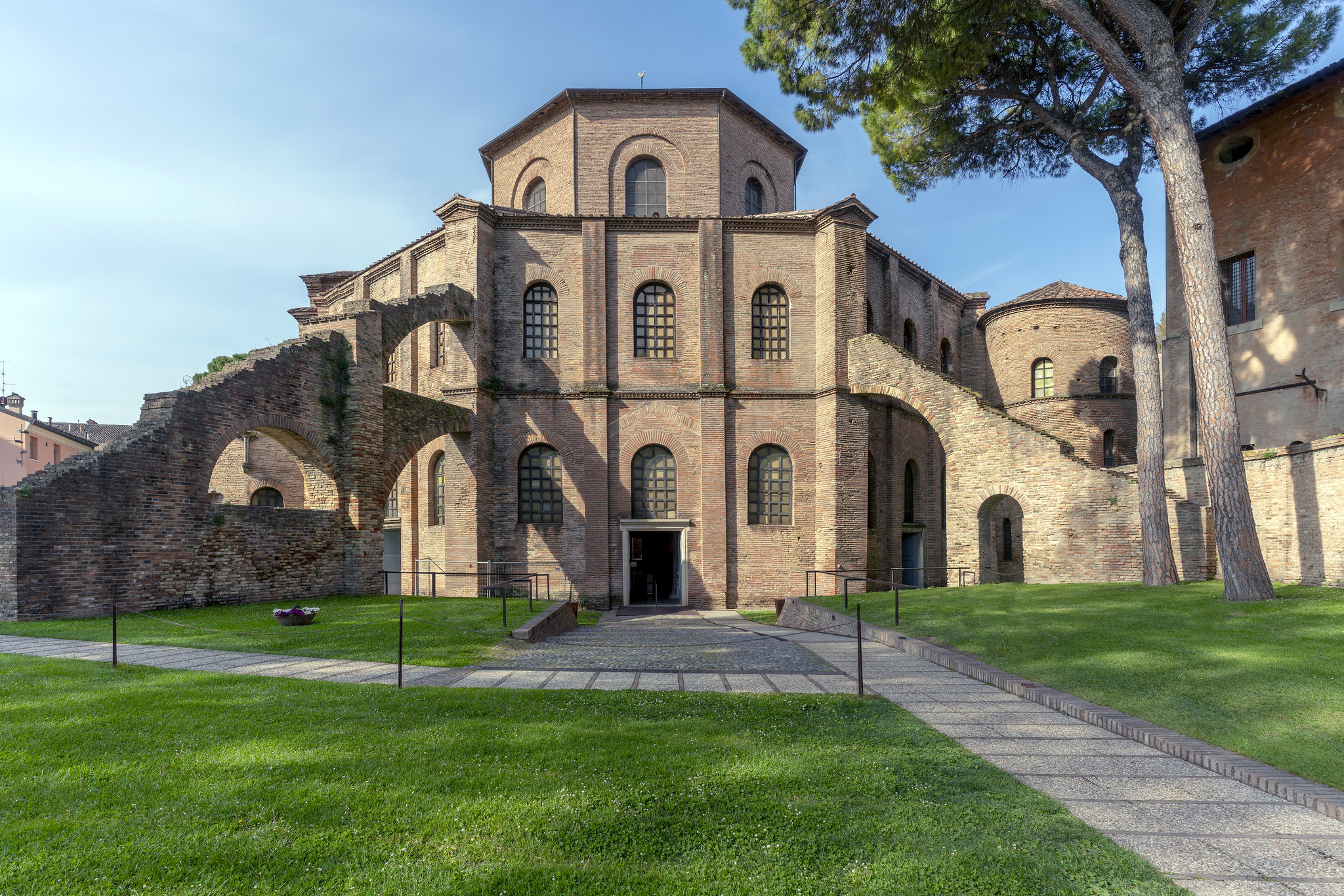 |
| San Vitale, Ravenna, Italy, 547 CE, Byzantine |
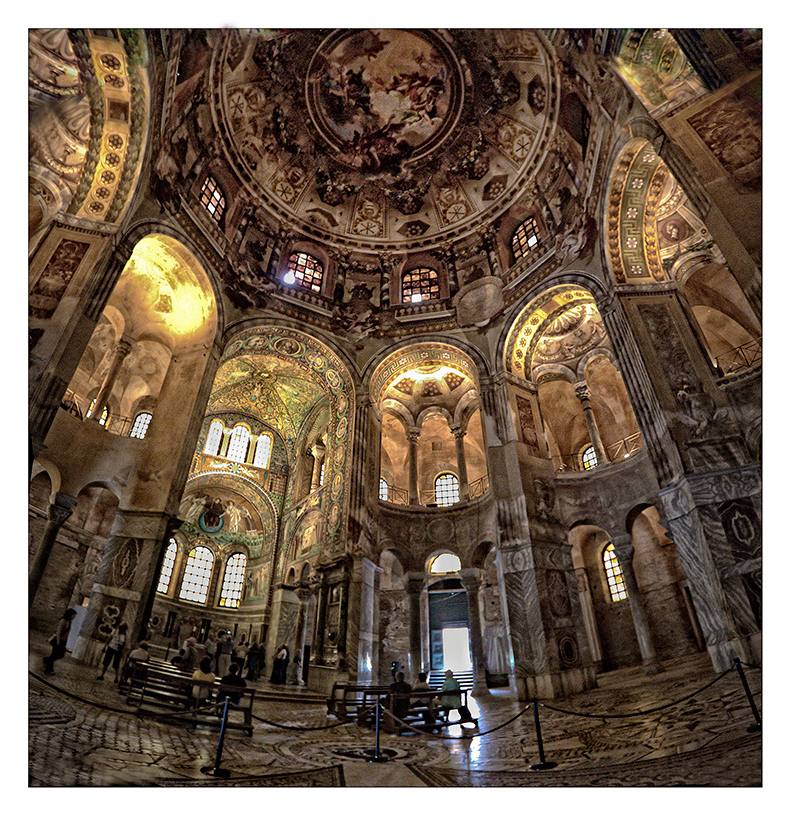
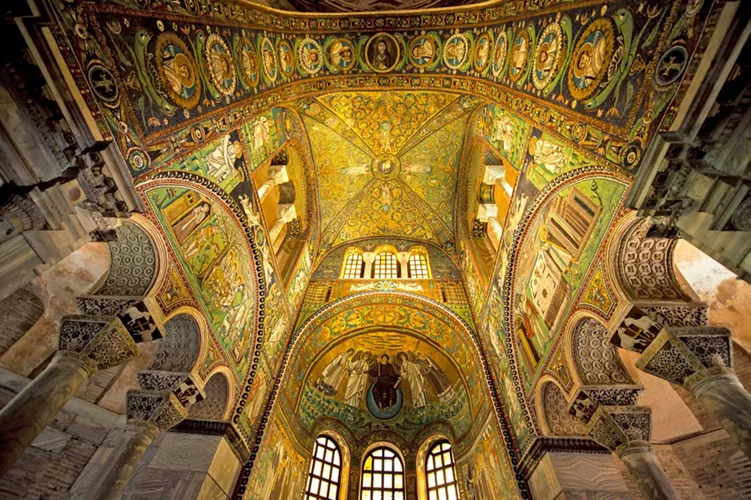
Early Christian style, full of poetic secrecy and cryptic symbols, gave way to Byzantine art by about 400 ce. The artwork of the Eastern Roman Empire, generally called the Byzantine Empire because Emperor Constantine I relocated the capital city to Constantinople, on the site of the ancient city of Byzantium, now known as Istanbul, Turkey.
For the Modern Irish Poet William Butler Yeats, Byzantine art stood for an ideal of perfection and permanence. Listen to Yeats reading his poem "Sailing to Byzantium" from 1928. In this segment you'll here the full poem read by the author followed by a second reading briefly annotated by images and commentary by me.
That is no country for old men. The young
In one another's arms, birds in the trees
- Those dying generations - at their song,
The salmon-falls, the mackerel-crowded seas,
Fish, flesh, or fowl, commend all summer long
Whatever is begotten, born, and dies.
Caught in that sensual music all neglect
Monuments of unageing intellect.
An aged man is but a paltry thing,
A tattered coat upon a stick, unless
Soul clap its hands and sing, and louder sing
For every tatter in its mortal dress,
Nor is there singing school but studying
Monuments of its own magnificence;
And therefore I have sailed the seas and come
To the holy city of Byzantium.

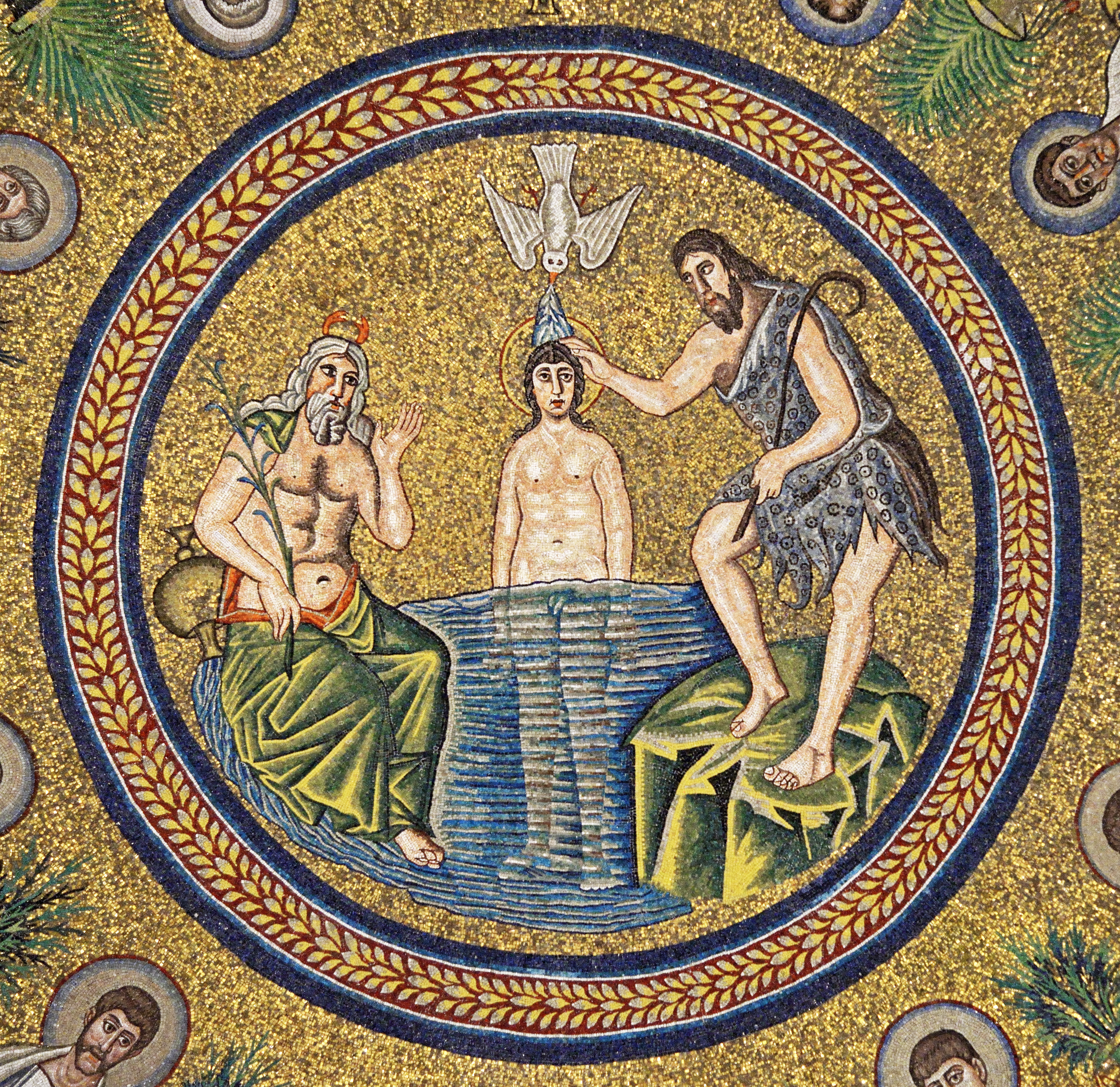
Baptism of Christ Mosaic, Arian Monastery, Ravenna, 550 ceO sages standing in God's holy fire
As in the gold mosaic of a wall,
Come from the holy fire, perne in a gyre,
And be the singing-masters of my soul.
Consume my heart away; sick with desire
And fastened to a dying animal
It knows not what it is; and gather me
Into the artifice of eternity.

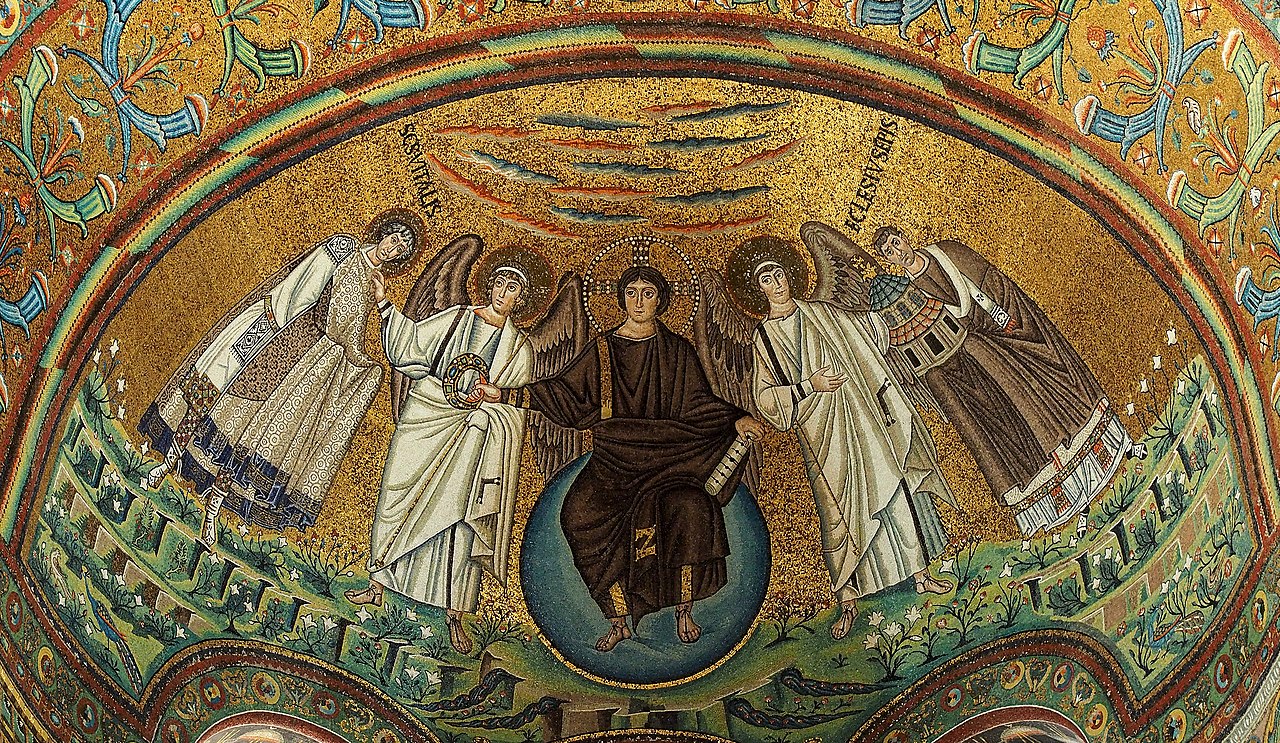
Dome Mosaic, , Ravenna, 6th c
Once out of nature I shall never take
My bodily form from any natural thing,
But such a form as Grecian goldsmiths make
Of hammered gold and gold enamelling
To keep a drowsy Emperor awake;
Or set upon a golden bough to sing
To lords and ladies of Byzantium
Of what is past, or passing, or to come.
William Butler Yeats, 1928
here's a straightforward page for help with the poem, but make sure you draw your own conclusions, too.

Next, we'll look at the largest monument of Byzantine Architecture, the Hagia Sophia in Constantinople (another key work!). Constructed from 532-537 ce, the Hagia Sophia, or Church of Holy Wisdom, remained a Christian place of worship until 1453, when Turks re-consecrated it as an Islamic Mosque, which it remained until becoming a museum to its own history in 1935 which it remains today.
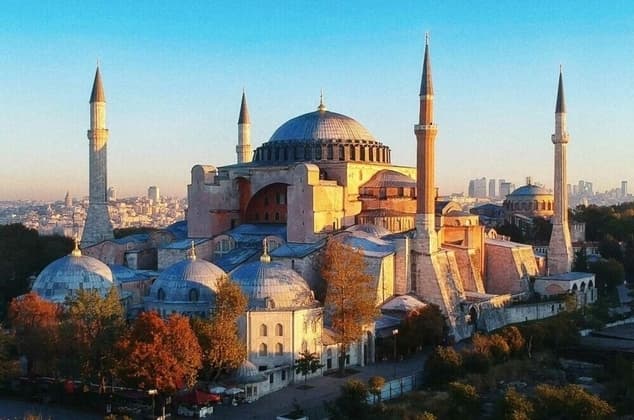
Hagia Sophia, 360 ce, Byzantine Cathedral, Istanbul, Turkey

interior of the Hagia Sophia, described in a long ekphrasis by Paul the Silentiary, thus: "The roof is compacted of gilded tesserae from which a glittering stream of golden rays pours abundantly and strikes men's eyes with irresistible force. It is as if one were gazing at the midday sun in spring, when he gilds each mountain top."
Icons, Iconography, Iconoclasts.
 |
| Empress Theodora and her Attendants, Apse Mosaic, San Vitale, Ravenna, 550 ce. (399) |
Russian orthodox church in Pennsylvania that Andy Warhol's family attended.

St Sava Serbian Eastern Orthodox Church NYC
As you look at the following segment, consider the differences you see in artistic styles from the Roman emphasis on colossal architecture to Christian emphasis on clear narration of specific stories. Make good notes, and pause the video several times to take time to describe some Early Christian artworks. After watching this video, you should know a bit about the emergence of art associated with early Christianity in the Roman Empire and the 'Ancient Near East' (that is, present day Turkey, Syria, and Iraq).
Early Christian Introduction from betsy towns on Vimeo.
More info on Byzantine art.

No comments:
Post a Comment