|
I use Edward Gorey's Grim Reaper as an image of Modernism, because under this grim umbrella stand crowds of inseparable little beings, here representing movements that fit, some comfortably and some barely covered, under the umbrella of Modernism.
|
What makes any definition of a movement in art dubious is that it never fits the deepest artists in the movement—certainly not as well as, if successful, it does the others. Yet without the definition something essential in those best is bound to be missed. The attempt to define is like a game in which you cannot possibly reach the goal from the starting point but can only close in on it by picking up each time from where the last play landed.
 |
| As we get closer and closer to our own time, the chaos of the game makes defining ever more difficult, and, as Innovation and Originality play critical roles in modernism, art movements hit us with increasing rapidity as we reach our own point on the timeline. |
Early Modernism 1500-1860
Note: ALL the dates in this post are necessarily approximations... transitions between periods of art sometimes seem to have happened in a flash-- with a revolutionary painting or work, but we can see traces of each of these periods before and after their flash of stardom. Likewise, most of these periods happen at slightly different times in different geographical areas.
In History, the period from about 1500-1800 is labeled the Early Modern Period. In Art History, many people call the period from about 1500-1860 the Early Modern Period, though others prefer to use only the narrower labels I list below. The following section pulls out the qualities of the following periods that connect them to the spirit of Modernism. I link to definitions of each period, which will not necessarily emphasize there Modern qualities, but will offer you further information on each period.
 |
| Michelangelo, David, 1500-1504, High Renaissance |

(Italian) Renaissance 1400-1600: Because the Renaissance began to consider Art for Art's sake, as we tend to view it today, it has strong connections to our modern idea of art. Though, in the Renaissance, art typically attached to a church or government patron, the individual artist's genius for imagining new possibilities defined the time, and that's how Modernism has defined Art: as based on an individual's creative mind. (Postmodernism has put emphasis back on collaboration, which played a significant role in artmaking before modernism! So I guess we can think of postmodern as premodern 😱)
 |
| Michelangelo Libyan Sibyl, from the Sistine Chapel Ceiling, 1514, Early Mannerism |
 |
| Parmigianino’s Madonna with the Long Neck 1535-40, Mannerism |
Mannerism-- the stylish style: you could consider Mannerism modern because it celebrated the individual artist's manner, or style. By this time, trained eyes can distinguish the 'hand' (or style) of one artist from another. Mannerist artists stepped outside of the austere formality of Renaissance convention to 'show off' their virtuosity.
 |
| Caravaggio, The Entombment of Christ (1603–1604) Baroque |
Baroque 1600- early 1800's: artists in this era emphasized the drama and emotional quality of the stories they told, and increased the Mannerist tendency to expect artists to have an individual style. One can connect these traits to Modernism's emphasis on the response of the individual to a given story or situation. (Note: not all periods of modernism celebrate the emotions... some movements put all the focus on expression, and some seek to flatten emotion in order to put focus on 'truth' and some try to take away meaning all together, emphasizing only form.) The focus on individual expression in the Baroque means that an enormous range of styles fit under the umbrella of Baroque: Velazquez, Rembrandt, Rubens, Artemisia all work with very different subject matter and technique, but all highlight drama and emotion, so all fit the Baroque definition.
 |
| Jean-Honoré Fragonard, The Happy Accidents of the Swing, 1767, French Rococo* |
Rococo 1700's: In the Rococo, artists further severed ties with the institutions that had controlled the art market up to this period, namely, the church and the state. As artists started making art for a broadening spectrum of patrons, they started tackling wider range subject matters. Few qualities of the Rococo seem modern (highly decorative, very playful, mostly concerned with aristocracy), but in the broadening subjects Rococo art tackles, you can locate a degree of Modern Spirit.
 |
| Jacques-Louis David, The Oath of the Horatii, 1794, Neoclassicism |
Neoclassicism late 1700's-early 1900's
Art of this period displays a marked contrast to the lighthearted frivolity of the Rococo. Classical ideals of unity, simplicity, clarity and proportion reigned, but now freighted with a much heavier political message than they had displayed in the Renaissance. The serious material of Neoclassicism, and the originality of using art overtly as an ideological tool reveal the Modern tones of Neoclassicism. Neoclassicism brought back stories and histories of Classical Greece and Roman as models for a changing France. With its interest in Philosophy, Science, and the Arts, you can also see why Neoclassicism is associated with The Age of Enlightenment.


 |
| Eugène Delacroix, Death of Sardanopolis, 1827, Romanticism |
Romanticism 1800-1850 :
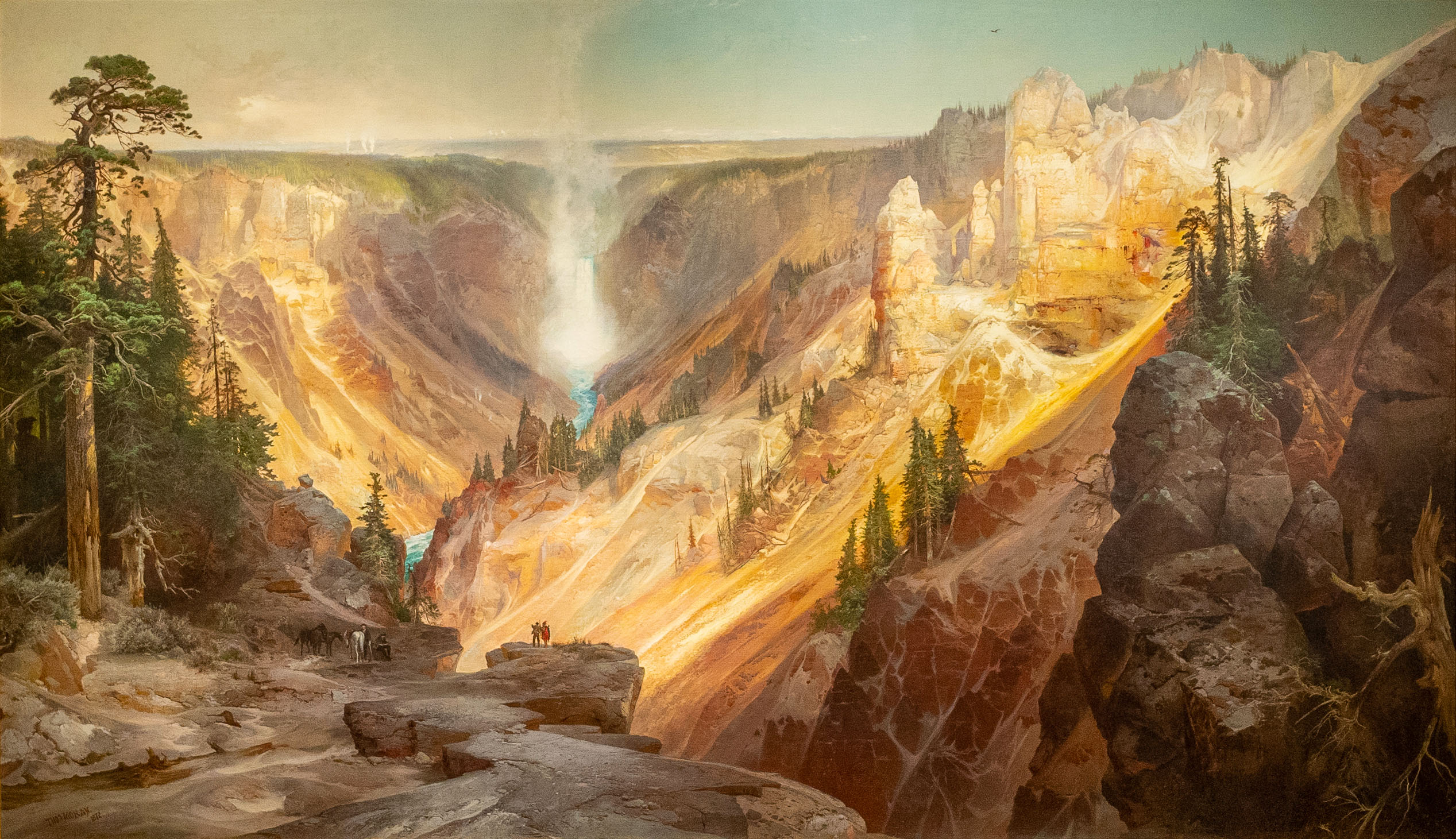
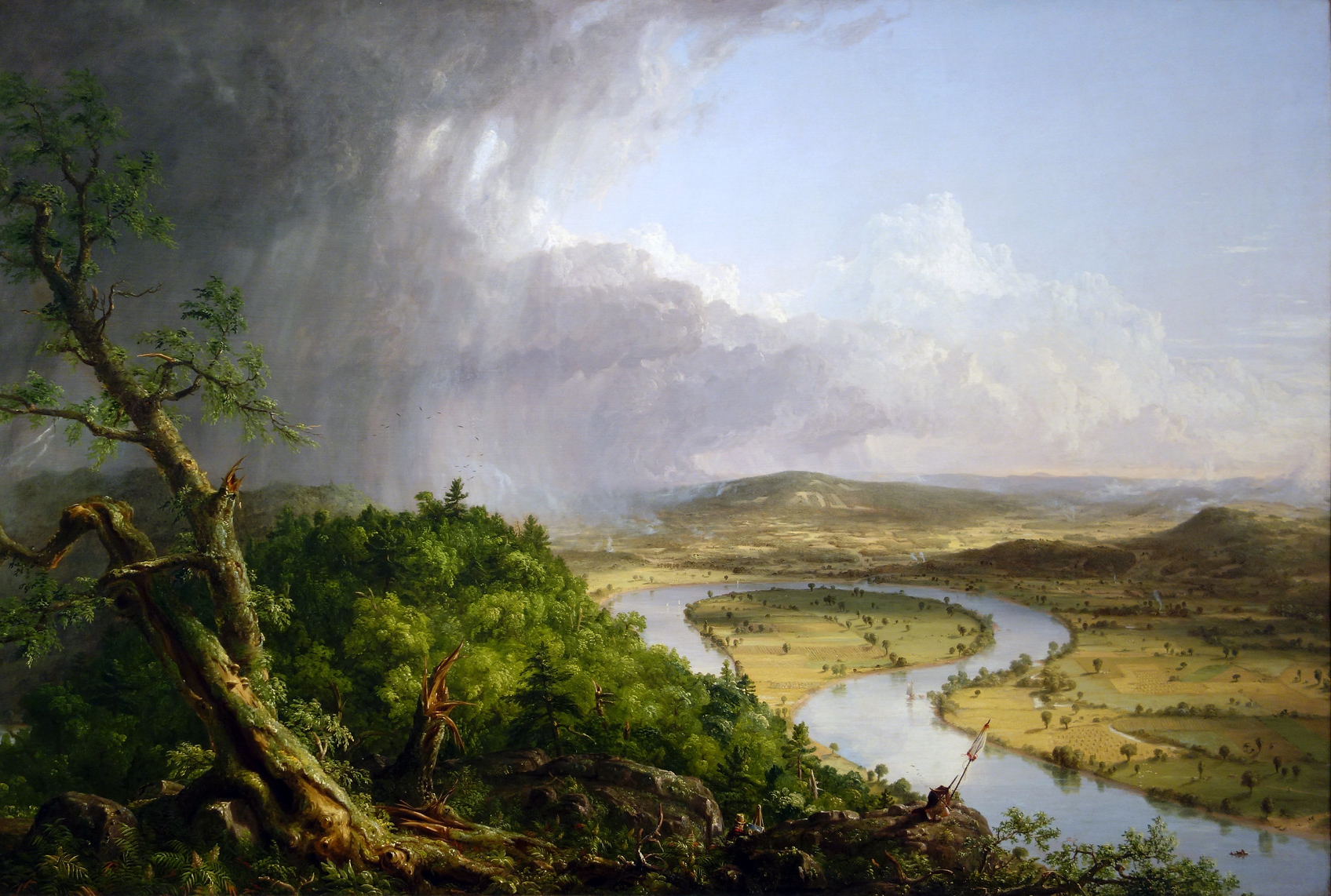
first called "Neo-Baroque," Romanticism shares dramatic emotionalism with Baroque, but used the drama to place new and significant emphasis on social issues and politics. Even the great Romantic landscapes have strong ideological message; look for it when you finish swooning over the rainbows and waterfalls. Romanticism celebrated the imagination of the individual artist, which marks it as another rung on the ladder of early modern almost to full Modernism. Just as Neoclassicism looks like a revolt against the moral and emotional excesses of Baroque, Romanticism shows a reaction to the restraint and rationality of Neoclassicism, the Age of Enlightenment, and much of Romanticism also demonstrates a return toward the natural world-- a reaction against Industrialization.
Two branches of American Romanticism that Might interest you are Hudson River School and Luminism:
 |
| Frederick Church, Niagara Falls, 1857 Hudson River School (Romanticism) |
 |
| Martin Johnson Heade, Sudden Storm, Newbury Marshes, ~1870 |
 |
| Gustave Courbet, The Stonebreakers, 1849, Realism |
Realism provides a transition between Early Modernism and Modernism Proper. Eduard Manet serves as key painter to illustrate that transition.... he began as a realist, if we take the definition of Realist Movement rather literally: he painted everyday subjects from direct observation. In his work, we can see the last vestiges of convention disappearing, for, unlike the Realists before him, and like the Impressionists who followed him, no subject is too small for Manet's major works.(Manet is seen as a bridge between Realism and Impressionism.) Below, he paints a boy leaning casually against an unlikely breakfast table (oysters and coffee??), amid the 'beautiful disorder' of the studio, but Manet steadfastly refuses to make sense out of the materials or models gathered before him. He has masterfully observed the objects, and shown them with the casualness of a snapshot, painting what he sees, rather than making sense out of the chaos of everyday life. The painting is modern in that it makes the viewer make the sense, rather than spelling the content out for us, as Courbet does with no room for confusion in the Stonebreakers.
 |
| Eduard Manet, Breakfast in the Studio, 1868. Realism, transition to Impressionism, and certainly Modernism |
Modernism (dates prove tricky! but in visual art, most agree that good reasons point to the mid-19th to mid-20th century bounding Modernism)
with "The Painter of Modern Life," 1863, poet, essayist, revolutionary Charles Baudelaire called for an artist who would shed the conventions that painting had carried for all of the Early Modern Period. He sought an artist who would turn to the world around, rather than to the stories of myth and history, for material. Modernism might learn from history, and take from it what it found useful, but Modernism, above all, rejected tradition and took the poet Ezra Pound's fiat: "Make it new!" as its central tenet. Thus, Modernism holds its umbrella above a shower of new movements in art, the Rain of -Isms, the Reign of -Isms.
 |
| Claude Monet, Haystacks, Sunset, 1890, Impressionism |
Impressionism (1867-1890) Like Manet, the Impressionists, most famously Claud Monet, Degas, Morisot, Cassatt, but there are many others, insisted upon direct observation. Indeed, the Post-Impressionist master, Paul Cezanne, famously stated, "Monet is just an eye, but my god, what an eye!" Impressionist painters, benefitting from the new technology of the paint tube, could take their paints out into the field and paint en plein aire-- in the open air-- and they did. The most famous Impressionist paintings take place out of doors and depict, above all, the way light falls on objects-- fleetingly-- actively changing them moment to moment. It is no coincidence that photography (light writing) and Impressionism (painting light) developed side by side. As with many of these -Isms, many artists work in a style that looks like Impressionism, and follows many of its principles. Because they are not part of the impressionist circle, or the time period of Impressionism, we call Impressionistic.
 |
| Vincent Van Gogh, The Night Cafe, 1888, Post-Impressionism |
Post-Impressionism (1880's-1905) Wishing to push beyond the direct observation of the visual truths, the Post Impressionists sought to express emotional or symbolic truth. Unlike the Impressionists, who gathered together to develop their new ideas, and showed their work together, Post-Impressionists, intent on finding individual modes of expression, worked, for the most part, independently. The most famous among them were Vincent Van Gogh, Paul Gauguin, Georges Seurat, and Paul Cezanne. Van Gogh retained the principle of direct observation of the subject painted, but used color with bold, yet intentional, expressive, rather than naturalistic intention. Gauguin sought private spiritual expression in his flat, boldly-outlined planes of color, and his exotic subject matter. Seurat, using his own technique now called Pointillism, placed dots of pure pigment side by side, allowing the viewer's eye, not his authorial hand, to do the mixing. Cezanne, the oldest and longest lived of this group, sought to look at nature through the basic shapes, forms and contrasts that make it up when flattened onto a canvas.
| Van Gogh, The Courtesan, 1887, After Eisen, Japonism |
Japonism (late 1800's) In the mid-1800's, after 200 years of isolation, during which Japan traded a bit with Holland, but otherwise excluded westerners and western influence in every way possible, Japan opened its borders to trade. Just at that time, Modernism was making France, in particular, but also England, hungry for novelty. The sudden importation of Japanese art and decorative objects seemed like a delicious feast for western artists, and they gobbled it up. Borrowing from the Japanese a perspective that pushed the artwork forward into the viewer's space, rather than one that lured the viewer into an illusion of depth, as well the interest in boldly assymmetrical compositions and large planes of color. The curving lines and natural forms of Japanese art significantly influenced the next period, Art Nouveau, as well.
 |
| Gustave Klimt, The Kiss, 1907 Art Nouveau (klimt is also considered a Symbolist) Art can exemplify multiple periods-- in this case, symbolism and art nouveau |
Art Nouveau (1890-1910) An international and highly decorative style, Art Nouveau presented an option to the academic style of the late 1800s, and drew on curving, organic lines inspired by the forms of nature. Art Nouveau style flourished in Architecture, Visual Art, fashion, clothing, urban design, and useful objects. In painting, Klimt and Alphonse Mucha are probably the most famous names; in architecture Antonin Gaudi is numero uno.
 |
| Emil Nolde, The Last Supper, 1909, Expressionism. |
Expressionism (early 20th Century) Expressionism developed simultaneously around several different geographical centers-- Norway, France, and most particularly Germany. Inspired by the Fauves use of extreme, expressive color, and Van Gogh's exploration of the inner spirit, the Expressionists placed emotions front and center, emphasizing the subjective quality of human experience. In Germany, Expressionism explored the dark, disturbing aspects of the mind. sub-Isms to Expressionism are: Der Blau Reiter, Fauvism, and Die Brüke. (images below)
 |
| Henri Matisse, Joy of Life, 1906, Fauvism (related to Expressionism) |
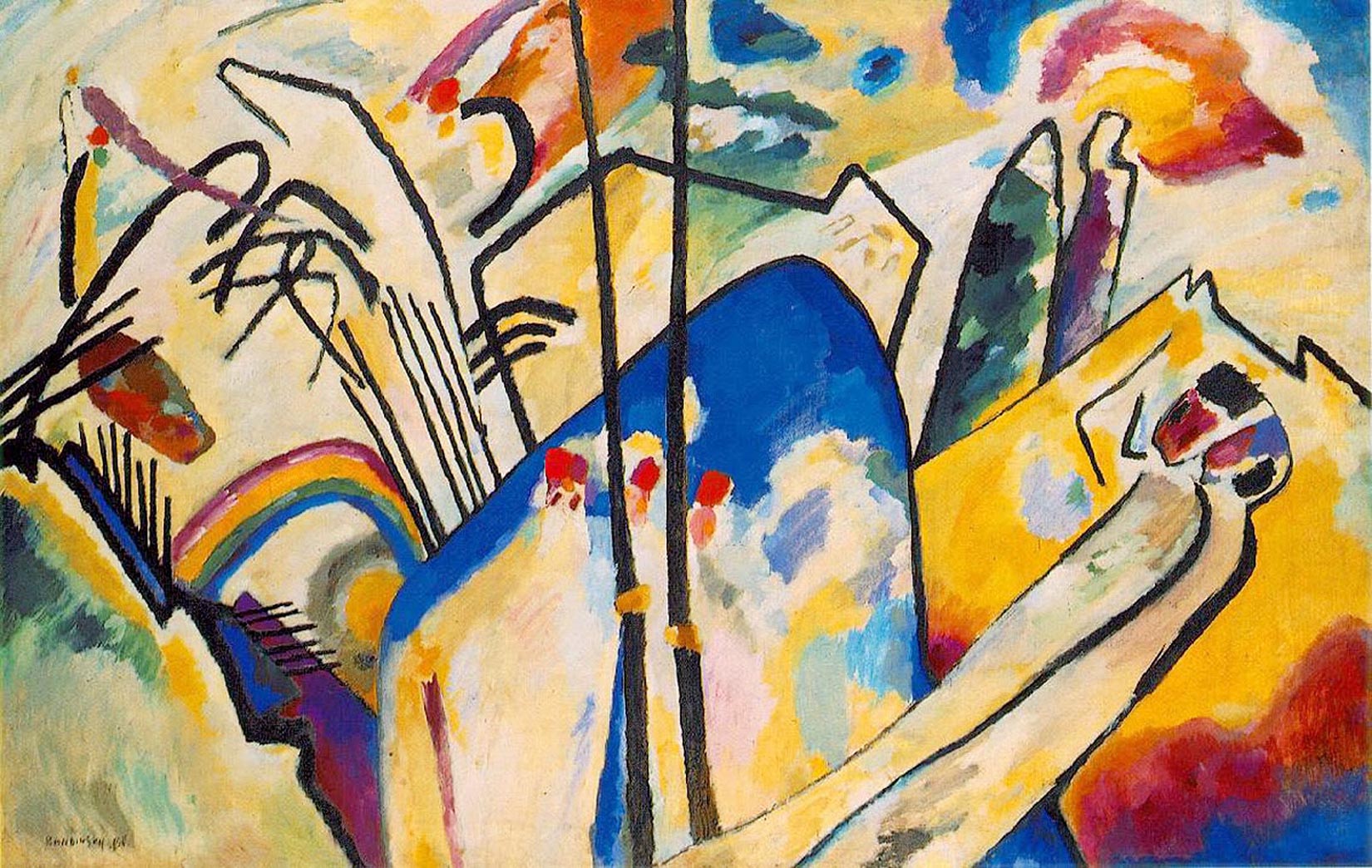 |
| Wassily Kandinsky, Composition IV, 1911 |
 |
| George Braque, Violin and Candlestick, 1910, Analytic Cubism |
 |
| Marcel Duchamp Fountain, 1917, photograph by Alfred Stieglitz at 291 art gallery following the 1917 Society of Independent Artists exhibit, with entry tag visible. The backdrop is The Warriors, a painting by Marsden Hartley. |
Dadaism (1916-1923) Begun in Zurich, Switzerland, as a reaction to WWI, Dadaism is an anti-art art. Artists lashed out at the workings of reason, logic, and convention, for if those had led to war, then those held no allure. Dada embraced nonsense, non art, the impulsive and the irrational. Much Dadaist art takes the form of action. Under Dada, for example, the gesture to pose a urinal on a pedestal, the creation of and existence inside an alter-ego, a public demonstration, for example, came under consideration as art, breaking apart traditional categories and classifications.
 |
| Andre Masson, Automatic Drawing, 1924, Surrealism |
 |
| Salvador Dali, Persistence of Memory, 1931, Surrealism |
Surrealism (1920-1935) As first defined by André Breton in his "First Manifesto of Surrealism" as Pure Psychic Automatism, Surrealism would have looked like Masson's Automatic Drawing, where the artist sought to detach his work from the controlling influence of the logical mind. Breton called for art that accessed the subconscious mind, suggesting that artists should access their dreams, mad wanderings, and unexpected connections, making work that would not only reveal the subconscious mind of the artist, but also help the viewer connect with the workings of their own subconscious. Surrealism, thus takes a long step toward increasing the power of the reader in interpreting the artwork, just as Freud worked to give his patients power over interpreting their dreams and the workings of their subconscious mind.
 |
| Umberto Boccioni, Unique Forms of Continuity in Space, 1913, Futurism |
Futurism (early 20th century)
This movement, centered in Italy, focused on the innovations of the 20th's century: technology, speed, automobiles, airplanes, trains, the city. You can find Futurism and futurist influence in painting, sculpture, interior design, architecture, theater, film, textile and industrial design. (They also have a great manifesto!)
 |
| Kazimir Malevich, Black Square, 1915, Suprematism |
Suprematism (1915-1925). Malevich started Suprematism, and gave it its name, based on his sense of the superiority of the style over all other movements, as it put the entire focus on formal qualities, particularly the purity of shape. Similar to futurism, Suprematism was a celebration of the Modern, but Suprematism put focus on the Real and the Precise over the imaginative.
 |
| Yoko Ono, Cut Piece, 1965, Fluxus. |
Fluxus:
 |
| Thomas Hart Benton, Bootleggers, 1927 |
Ashcan School

Constructivism
 |
| Andrew Herman, Portrait of the Artist with one of her works, 1938 |
 |
| Diego Rivera, Man, Controller of the Universe, 1934, Social Realism |


Jackson Pollock, Number Five, 1948, 1948, Action Painting, Barnett Newman, Onement I,1948, Color Field Painting. Both paintings are Abstract Expressionism.
Abstract Expressionism in the late 1940's and early 1950's, both American and ex-patriot European artists centered in New York, but not closely associated with each other, pushed vigorously against the remaining boundaries of artistic convention that Modernism has not already demolished. Building on Surrealism's pure psychic automatism, but retaining intent focus on formal qualities, Abstract Expressionists left recognizable subject matter behind and placing further interpretive demands on viewers and critics. Thus, abstract expressionism has received widely disparate reactions and readings. Many consider Ab-Ex as to follow from Surrealism's automatic approach, seeing the artists as working directly from their subconscious (Jackson Pollock said that he does not illustrate feelings, he expresses them), others saw Ab-Ex as nihilistic, anti-art, in that it seemed to move away from everything art had been, others saw pure abstraction as a reaction to the horrors of WWII (how could artists express anything in a world gone so far awry), and still others saw content (landscapes, flowers, interactions between forms indicating human relationships or emotions). Generally, people see two major tendencies in Abstract Expressionism, which we describe as Action Painting and Color Field Painting, depicted above.
 |
| Andy Warhol, Pop Art |
Pop Art
 |
| Robert Smithson, Spiral Jetty, Land Art |
Earth Art (Land Art)
 |
| Magdalena Abacanowicz, performance art |
Performance Art
 |
| Joseph Alpers, Minimalism |
Minimalism
 |
| Flux Year Box 2, c.1967, a Flux box edited and produced by George Maciunas |
 |
| Banksy, Naked Man, 2008, Street Art |
 |
| Sherry Levine, Fountain (Madonna) 1991. source I will have to disappear this image shortly, as the owners do not allow appropriation! |
 |
| Rachel Whiteread, Embankment, 2005 |
Feminist Art
Installation Art
 |
| Jean-Michel Basquiat, Head, 1984, Neoexpressionism |
 |
| Tracy Emin, My Bed, 1999, Young British Artists, |
Young British Artists
 |
| Billy Childish, The Drinker, 1994, Stuckism |
Stuckism
 |
| Richard Estes, Telephone Booths, 1968, photorealism |
Photorealism
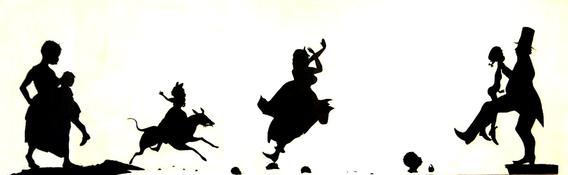 |
| Kara Walker, The Means to an End--A Shadow Drama in Five Acts, 1995, Contemporary African American Art |
Contemporary African American Art
Postwar European Figurative Painting
Video Art