Thursday, September 10, 2026

The Renaissance in Italy, An Introduction

 Italian and Northern Renaissance HW. 

1st-- classwork will probably run a little bit behind homeowkr until week 5, because we spend so much time on Art Historical Methods early on. We will catch up with ourselves and the syllabus! 

Thusday, Sept 10 we will start with discussion on the two major Key Works from the Kingdom of Benin-- the Ivory Mask of an Iyoba and the so-called Benin Bronzes.  I'd like you to think about how the multiple contexts (so far) for the bronzes add to and shift their meanings. 

  1. Hung in chronological sequence in the the courtyard of the palace of the Oba (the King)
  2. Removed from the courtyard and preserved inside that palace by later rulers
  3. Distributed to global museums-- mainly the British Museum -- after the punitive looting of the palace in 1897 by British armed forces

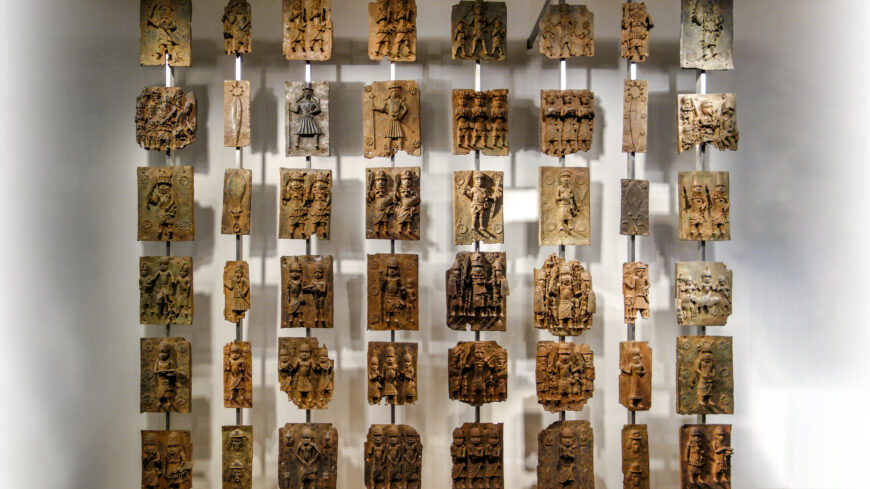
Benin Bronzes | British Museum
Above, visitors consider some of the "Benin Bronzes" in the British Museum. Parts of this collection can also be seen all over the world, which is very important to what they have come to symbolize.
Where  can they be seen? In Nigeria objects from the Kingdom of Benin are housed in the collections of the National Commission for Museums and Monuments (NCMM)(Opens in new window), and some are displayed in the national museums in Benin City, Lagos, Ibadan, Enugu, Kaduna and Jos. However, the majority of the objects are in institutions around the world with the British Museum and the Ethnologisches Museum(Opens in new window), Berlin, having the largest collections. The following European and UK museums also have important collections, some of which have now been legally transferred to Nigerian ownership, though most remain physically in Europe: Weltmuseum(Opens in new window), Vienna, Austria; Museum of Archaeology and Anthropology,(Opens in new window) Cambridge, UK; Rautenstrauch-Joest-Museum(Opens in new window), Köln, Germany; Museum für Völkerkunde(Opens in new window), Dresden, Germany; Museum am Rothenbaum(Opens in new window), Hamburg, Germany; GRASSI Museum für Völkerkunde zu Leipzig(Opens in new window), Leipzig, Germany; Linden-Museum(Opens in new window), Stuttgart, Germany; Nationaal Museum van Wereldculturen(Opens in new window), Netherlands; Pitt Rivers Museum(Opens in new window), Oxford, UK; National Museums Scotland(Opens in new window), UK; Statens museer för världskultur(Opens in new window), Stockholm, Sweden. In the USA there are significant collections in Chicago, Boston, New York, Washington and Philadelphia. (from the British Museum website)


The Art and Artists of the Italian Renaissance 1400-1700

Next-- we dive into the Italian Rennaissance. It's impossible to know too much about this time because that time and place established: 
  1. what art history is
    Jacopo Zucci, Portrait of Giorgio Vasari, ~1572
    Vasari was the author of the Lives of the Most Excellent Painters, Sculptors, and Architects, considered the methodological and ideological foundation of much of Western and even global art-historical writing

  2. the definitions of art, artists, modernism, and illusionism that we impact global art history today,
  3. classical compositional forms, which define the ways people study in conservatories,
  4. the foundations of how we look at and talk about painting, sculpture, and architecture, 
  5. a set of works and ideas that govern many people's definition of excellence today, and more. 
Three introductory essays that will set up our discussion of Renaissance Art in Italy 

You might consider reading straight through them for the 10th, then go back to skim aspects parts you want to remember in preparation for the 14th and 17th. 

Important terms definitions: 
Renaissance: a period of re-awakening in history, with the 14th-17th European Renaissance being a uniquely self-aware reinstitution of Greek and Roman arts, literature, and aesthetics emerging in Italy and spreading a studia humanitatis aimed at teaching the ethics and values that they believed would lead to a virtuous, active, civic life, work, and system of governance. 

Renaissance Humanism: the educational, intellectual and more rarely spiritual program of the Renaissance Humanists believe in the value of classical learning and of individual humanity. 

Patron
Connoisseur(ship)

Key Concepts regarding the Renaissance
Who: Humanists: 
  • turn to the scientific method when seeking understanding of how the earth and universe work
  • make decisions based on reason and concern for humanity
  • believe in the inherent value of humanity. 

Artist/Artisan/Craftsperson
In Europe, until the time of the Renaissance, a career making visual art cast the makers in a lower class than, for example, poets, musicians, scientists, philosophers as well as the merchants and leisured aristocrats; art-makers made things with their hands, rather than their minds or pocketbooks, and thus were craftspeople.  Our colleagues in D&P, say, in scene painting, might really understand this-- as surely do some parts of filmmaking. 
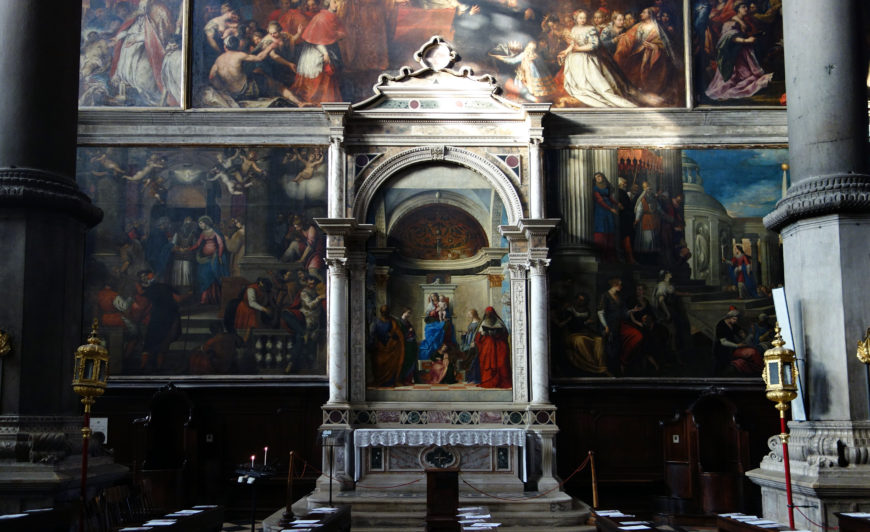
 
Giovanni Bellini, San Zaccaria Altarpiece, 1505, oil on wood transferred to canvas, 16 feet 5–1/2 inches x 7 feet 9 inches (San Zaccaria, Venice; photo: Steven Zucker, CC BY-NC-SA 4.0)
Giovanni Bellini, San Zaccaria Altarpiece, 1505, oil on wood transferred to canvas, 16 feet 5–1/2 inches x 7 feet 9 inches
The definition of art as separate, and of artists as thinkers, innovators, even creative geniuses, came about in part because of some potent lobbying on the part of folks like Leonardo, Michelangelo, and Raphael, as well as Alberti and Vasari who recorded their histories. 


What? painting, sculpture, architecture- 
     many artists did all three
    what's missing from this list? 

iconography- religious, secular (new genres, classical subjects, contemporary subjects) 

style

interpretation

When
  1. 600 B.C.E.–400 C.E. Ancient Greece and Rome (also known as the classical past or classical antiquity, this 1,000 year span of time is itself broken by historians and art historians into smaller designations, such as archaic, high classical, hellenistic, etc.)
  2. 400–c. 1400 the Middle Ages (c. 1200–1400 is often called the Late Middle Ages)
  3. 1400–1600 the Renaissance
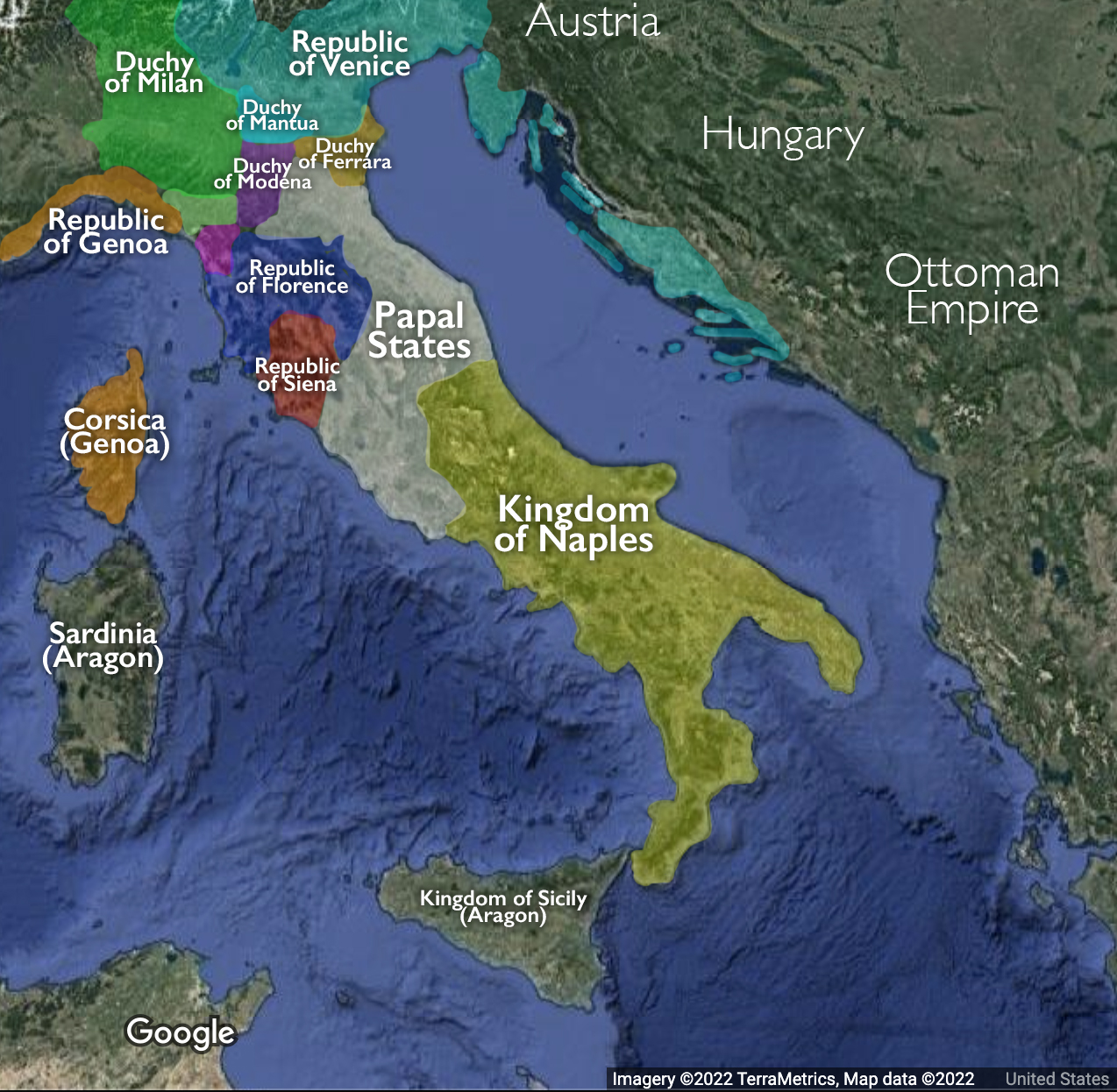
Map of Italy in 1494 (underlying map © Google)

Where? Western Europe

TRANSITIONS
Byzantine in Ravenna


Ravenna, Basilica of San Vitale, apse vault, mosaic of Christ Pantokrator, Saint Vitalis of Milan, Bishop Ecclesius, and two angels (completed 547) 


The Hospitality of Abraham and the Sacrifice of Isaac
Byzantine Period


Ceiling mosaic above the presbytery with the Lamb of God in its centre. source. 


Many formal values that-- whether we want them to or not-- govern the ways we look at art in the US emerged in the European Renaissance, and prove tricky to escape! For example, "Linear perspective, volumetric figures rendered with anatomical precision, emotionally charged expression, and visual naturalism are formal elements popularized in the Renaissance. This was especially true of art in Italy where ancient Roman art demonstrating many of these traits was abundant (such as Roman relief sculpture and architecture)." Smarthistory We are so familiar with these capacities defining what makes good art that it can be difficult to pick up different measuring sticks. Is this still true? 

Qualities of Byzantine Art: brick or stone exteriors; Glittering, complicated, detailed, ornamental, fantastic, organic Interiors. 

Qualities of Renaissance Art: Restraint, unity, balance, proportionality, illusionism, harmony, individuality, humanity
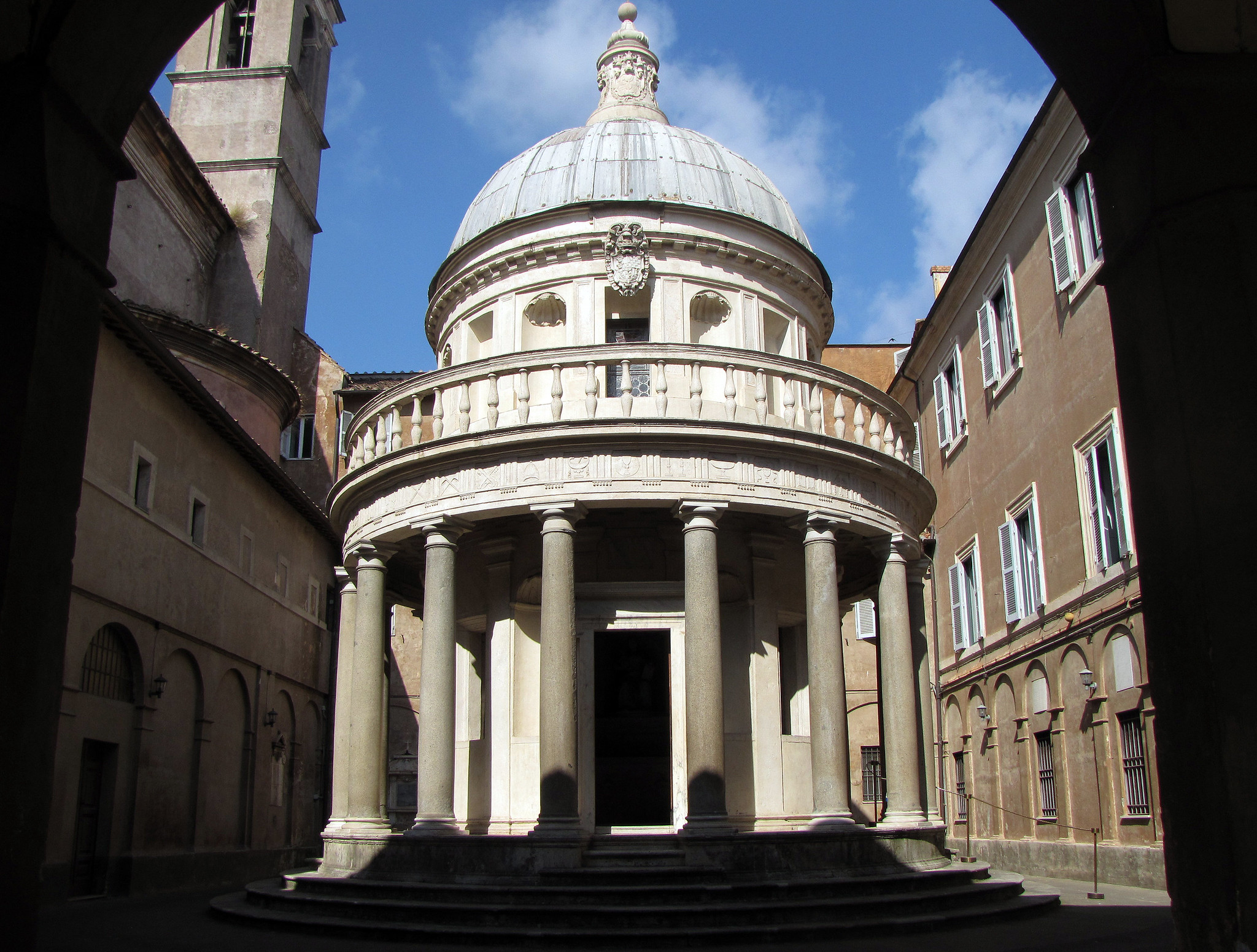
Donato Bramante, Tempietto, c. 1502, San Pietro in Montorio, Rome

Donato Bramante, Tempietto, c. 1502, San Pietro in Montorio, Rome


Giotto-- Scrovegni Chapel, Arena Chapel

The Scrovegni Chapel  also known as the Arena Chapel, is a small church in Padua, Northern Italy, commissioned by wealthy banker Ernesto Scrovegni in early 1300's proto-Renaissance
'


View towards the Apse and Altar, Scrovegni Chapel, frescos by Giotto. 
proto-Renaissance
'
Scrovegni Chapel, detail illustrating some of the 3-register frescos by Giotto di Bondone; top register showing The Life of the Virgin Mary, middle: Life of Christ; bottom: Passion (or the series leading up to the death and resurrection of Christ) and the 7 virtures. The total wall sequence is 38 fresco panels; the chapel interior is 68.5 ft long, 27.6 ft wide, and 41.5 ft high

vocab: 
  • fresco, 
  • register, 
  • Giotto, 
  • Renaissance naming traditions; 
  • image naming standards (Artist or Author, Title, date, period, possibly location and materials)
  • Byzantine, 
  • proto-Renaissance, Renaissance in European Art History, 
    • Linear perspective, 
    • volumetric figures rendered with anatomical precision, 
    • emotionally charged expression, and 
    • visual naturalism
  • Renaissance generally, 
  • features of modern art already visible in European art, leading to it often being known as the beginning of the 'Early Modern Period' in global art history

Vasari, author of "Lives of the Artists", relates that when the Pope sent a messenger to Giotto, asking him to send a drawing to demonstrate his skill, Giotto drew a red circle so perfect that it seemed as though it was drawn using a pair of compasses and instructed the messenger to send it to the Pope. The messenger departed ill pleased, believing that he had been made a fool of. The messenger brought other artists' drawings back to the Pope in addition to Giotto's. When the messenger related how he had made the circle without moving his arm and without the aid of compasses the Pope and his courtiers were amazed at how Giotto's skill greatly surpassed all of his contemporaries


9 ⁄ 75 More details Padua: Scrovegni Chapel. Giotto frescoes in 38 panels with stories of Mary and Christ. 1, Expulsion of Joachim from the temple; 2, St. Joachim shelters among the shepherds; 3, The angel announces to St. Anne that she will be a mother; 4, The angel announces to St. Joachim, the sacrificant, that his prayer will be answered (the composition repeats, placed outdoors with a shepherd replacing the maid); 5, St. Joachim's dream; 6, Meeting of Joachim and Anna at the Golden Gate of Jerusalem; 7, Nativity of Mary; 8, Presentation of Mary at the temple; 9, Delivery of rods to St. Simeon; 10, Prayer for the flowering of the rods; 11, Marriage of Mary; 12, Wedding procession of Mary; 13, God the Father entrusts the Annunciation to Mary to the Archangel Gabriel; 14, Annunciation; 15, Visitation; 16, Nativity of Jesus; 17, Adoration of the Magi; 18, Presentation of Jesus at the temple (on the left, Fanuel's daughter with prophecy scroll); 19, Flight into Egypt; 20, Massacre of the Innocents; 21, Jesus among the doctors; 22, Baptism of Jesus; 23, Wedding at Cana; 24, Resurrection of Lazarus; 25, Entry of Jesus into Jerusalem; 26, Expulsion of merchants from the temple; 27, Judas receives the price of betrayal; 28, Last Supper; 29, Washing of the feet; 30, Judas kiss; 31, Jesus before Caiaphas; 32, Coronation with thorns; 33, Ascent to Calvary; 34, Crucifixion; 35, Deposition; 36, Resurrection; 37, Ascension; 38, Pentecost. In Guida Rossa Veneto Touring Club Italiano


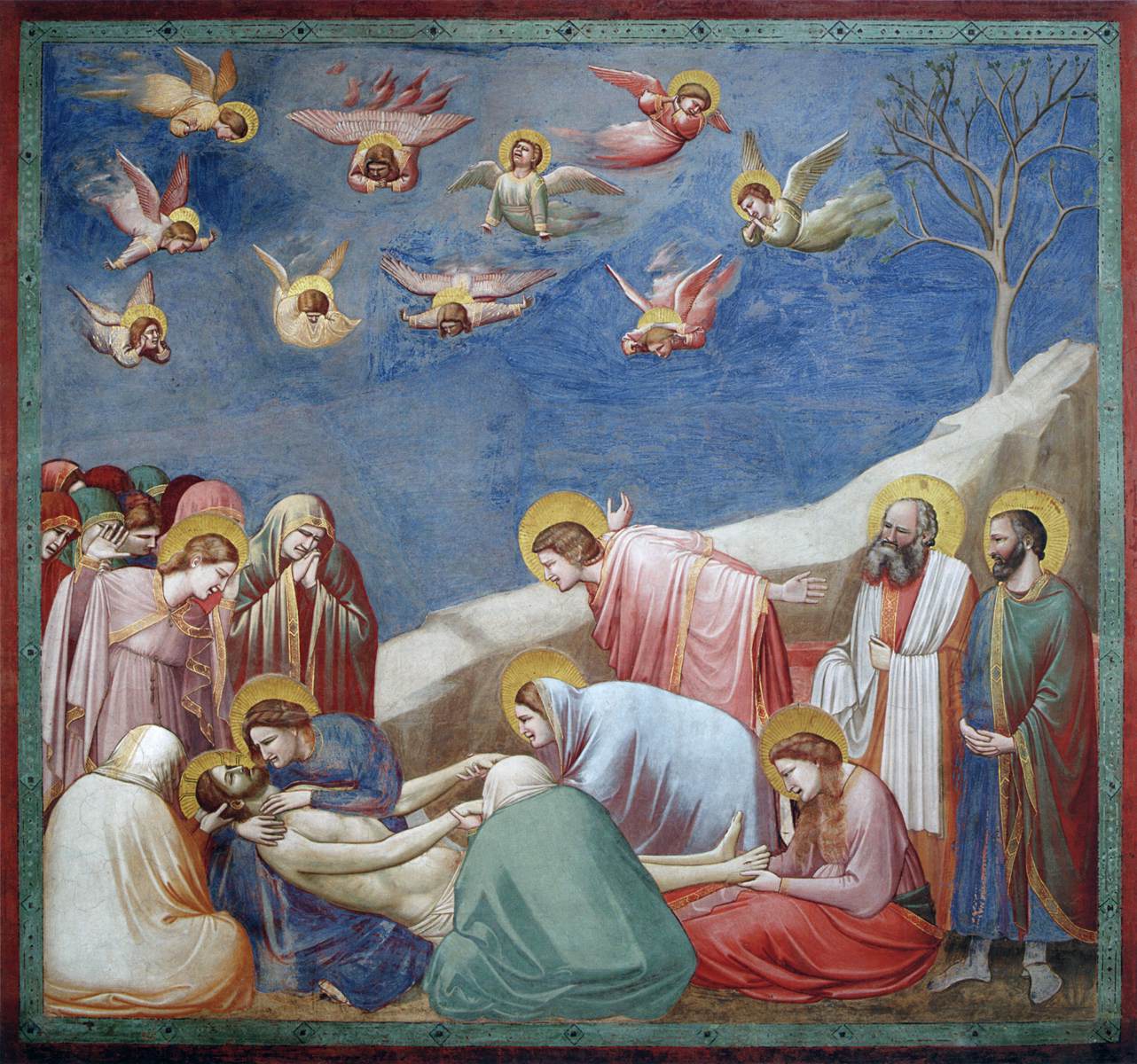
Giotto di Bondone,  Lamentation over the Dead Christ, 1305, fresco,  Scrovegni Chapel, Padua, Italy


Giotto di Bondone,  Joachim among the Shepherds, 1305, fresco,  Scrovegni Chapel, Padua, Italy 


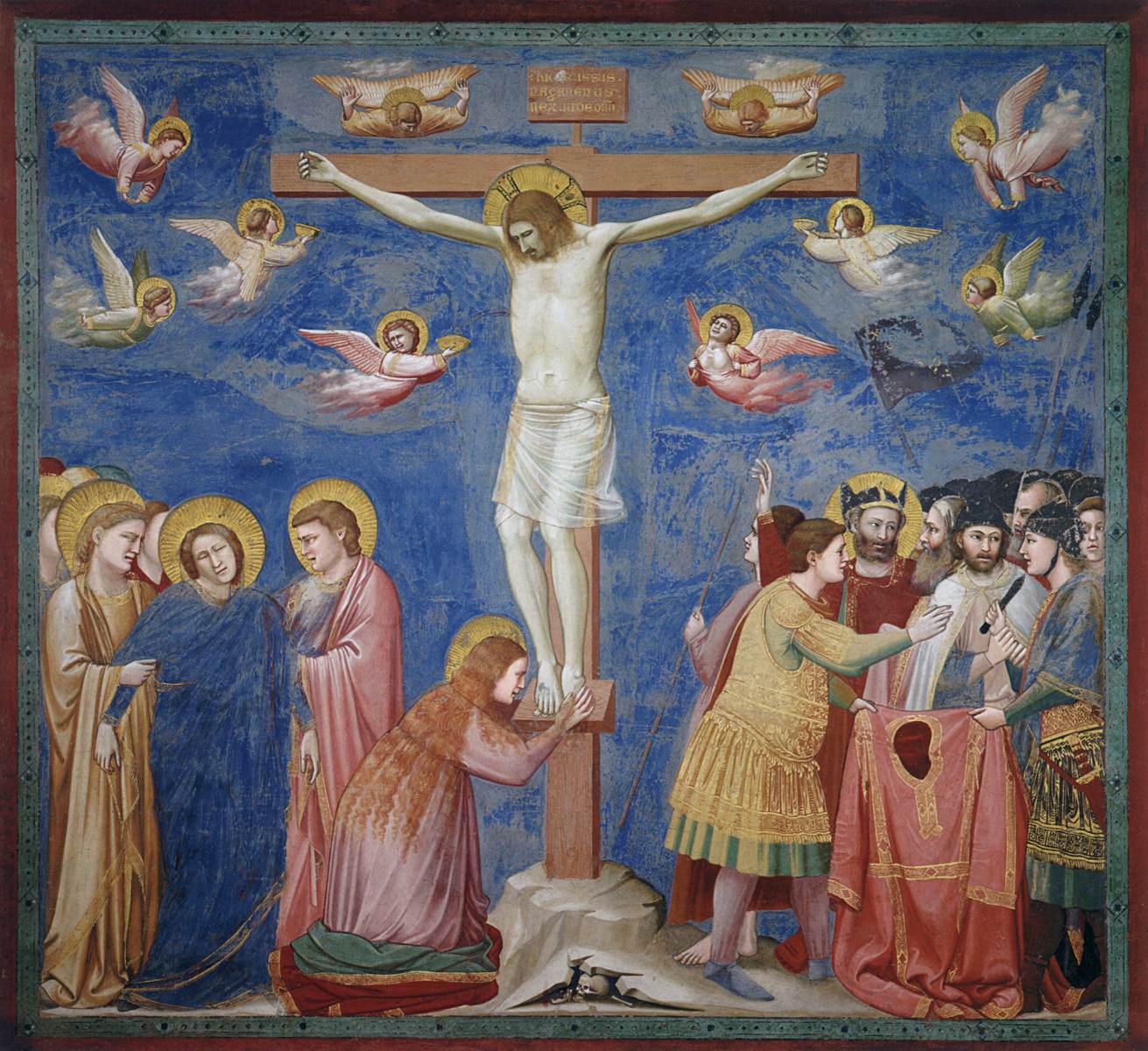
Giotto di Bondone,  Crucifixion, 1305, fresco,  Scrovegni Chapel, Padua, Italy


Betsy Giotto
Aiden Ghiberti
Sam Perugino
Bella Botticelli
Mercy Leonardo; Mercy Michelangelo
Akarsh Donatello & Michelangelo
Sam Raphael 
Betsy Sistine Chapel
Kaitlin  Raphael Galatea and popes


Betsy: Giotto, Scrovegni Chapel frescos Annunciation and Lamentation; Michelangelo, Sistine Chapel Ceiling1508-1512

Betsy: Giotto, Scrovegni Chapel frescos Annunciation and Lamentation; Michelangelo, Sisting Chapel Ceiling
Aidan Ghiberti, Gates of Paradise Links to an external site., 1425-1452  (Aidan you just get one work because it has so many elements to consider it should count as several! (web gallery of art- alternative readingLinks to an external site.) 

Sandro Botticelli, The Birth of Venus (c. 1484–1486). Tempera on canvas. 
 (67.9 in × 109.6 in). Uffizi, Florence


Titian, Venus of Urbino, 1534 oil on canvas

Titian, Venus of Urbino


Raphael, Portrait of Pope Leo II, 1511


Raphael, Portrait of Pope Leo X, 1518-1520


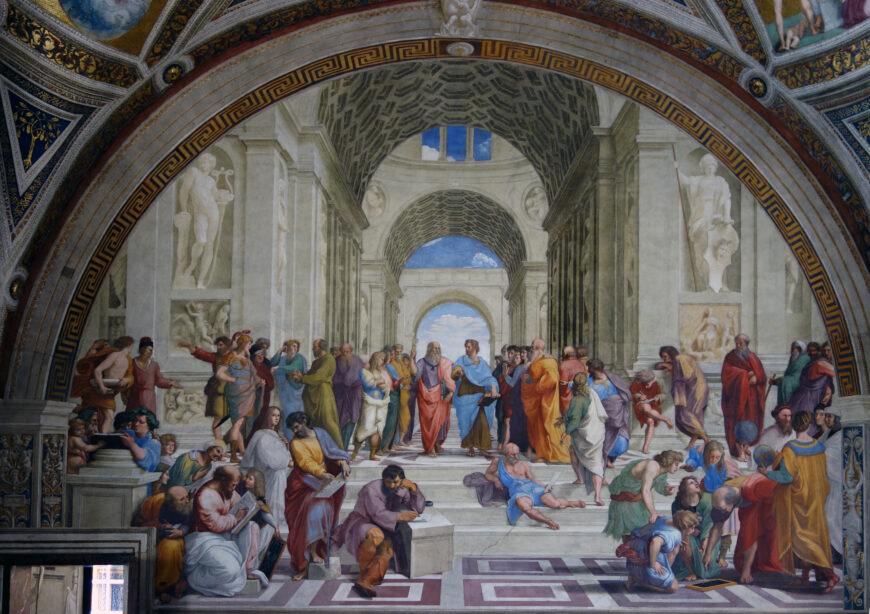
Raphael, School of Athens, fresco, 1509–11 (Stanza della Segnatura, Papal Palace, Vatican; photo: Steven Zucker, CC BY-NC-SA 4.0)


Heraclitus, whose features are based on Michelangelo's and his seated pose is based on the prophets and sibyls from Michelangelo's frescoes on the Sistine Chapel Ceiling (detail), Raphael, School of Athens, 1509-11, Stanza della Segnatura (Vatican City, Rome)
Michelangelo, Self Portrait as Heraclitus (the classical philosopher), 1508-12


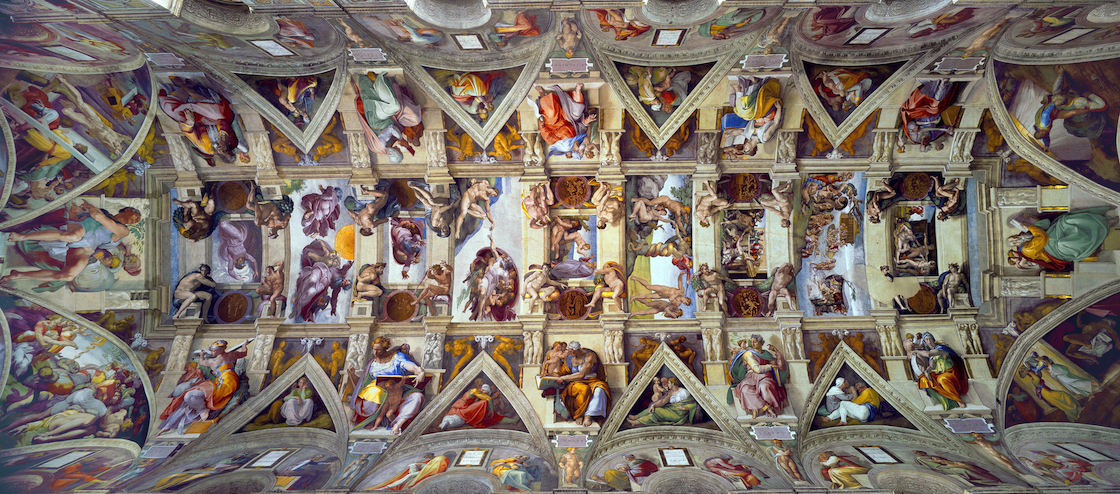
Michelangelo, Ceiling of the Sistine Chapel, 1508–12, fresco (Vatican City, Rome)
Michelangelo, Ceiling of the Sistine Chapel, 1508–12, fresco (Vatican City, Rome) 


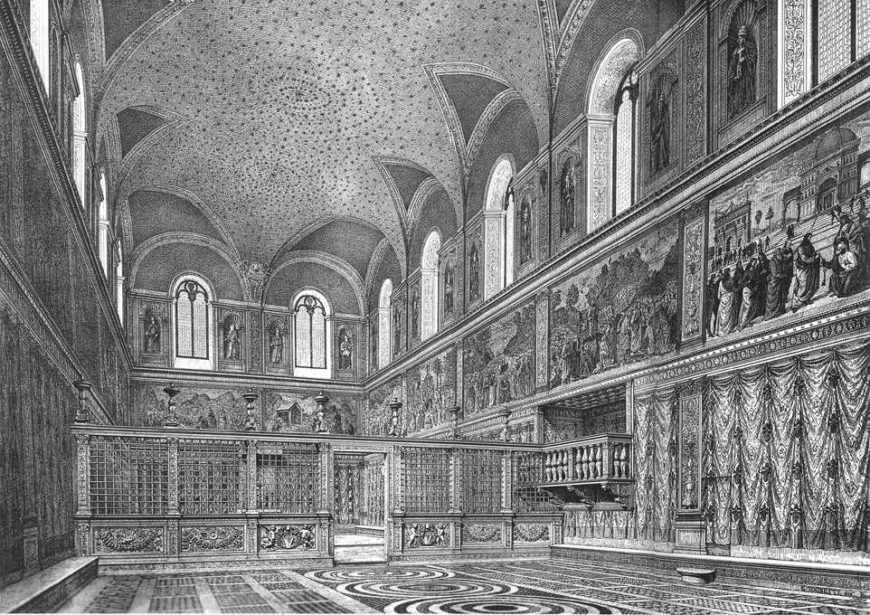
Reconstruction of the Sistine Chapel prior to Michelangelo's frescoes
Chapel Prior to painted ceiling. Google Maps Sistine Ceiling. 


Diagram of the subjects of the Sistine Chapel [1] (photo: Begoon, CC BY-SA 3.0)
The Sistine chapel is 68' high,134 feet long and 44 feet wide.  
 .    Here are some fun facts, collected by Tanya Möderscheim. 


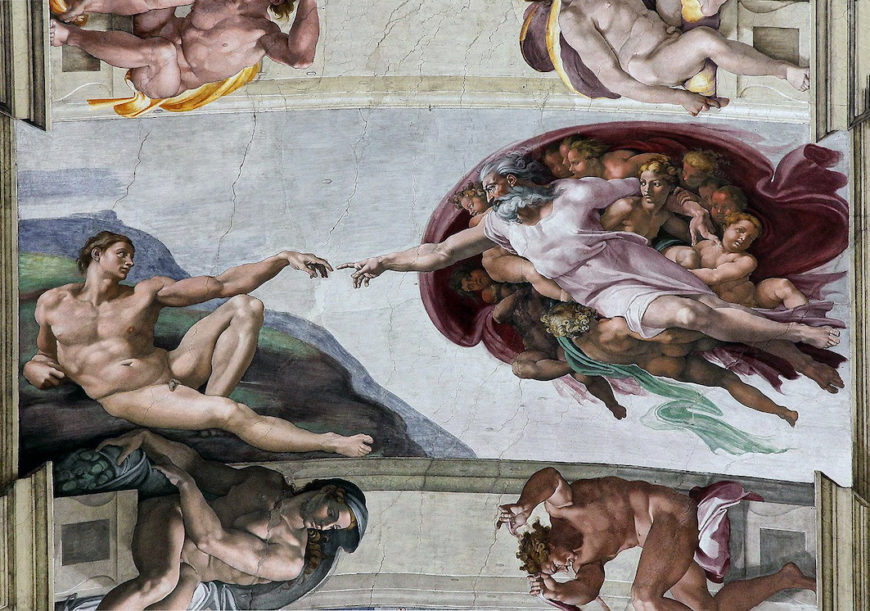
Michelangelo, The Creation of Adam, Ceiling of the Sistine Chapel, 1508-1512, fresco (Vatican City, Rome; photo: Jörg Bittner Unna, CC BY 3.0)
Michelangelo, The Creation of Adam, Ceiling of the Sistine Chapel, 1508–12, fresco 


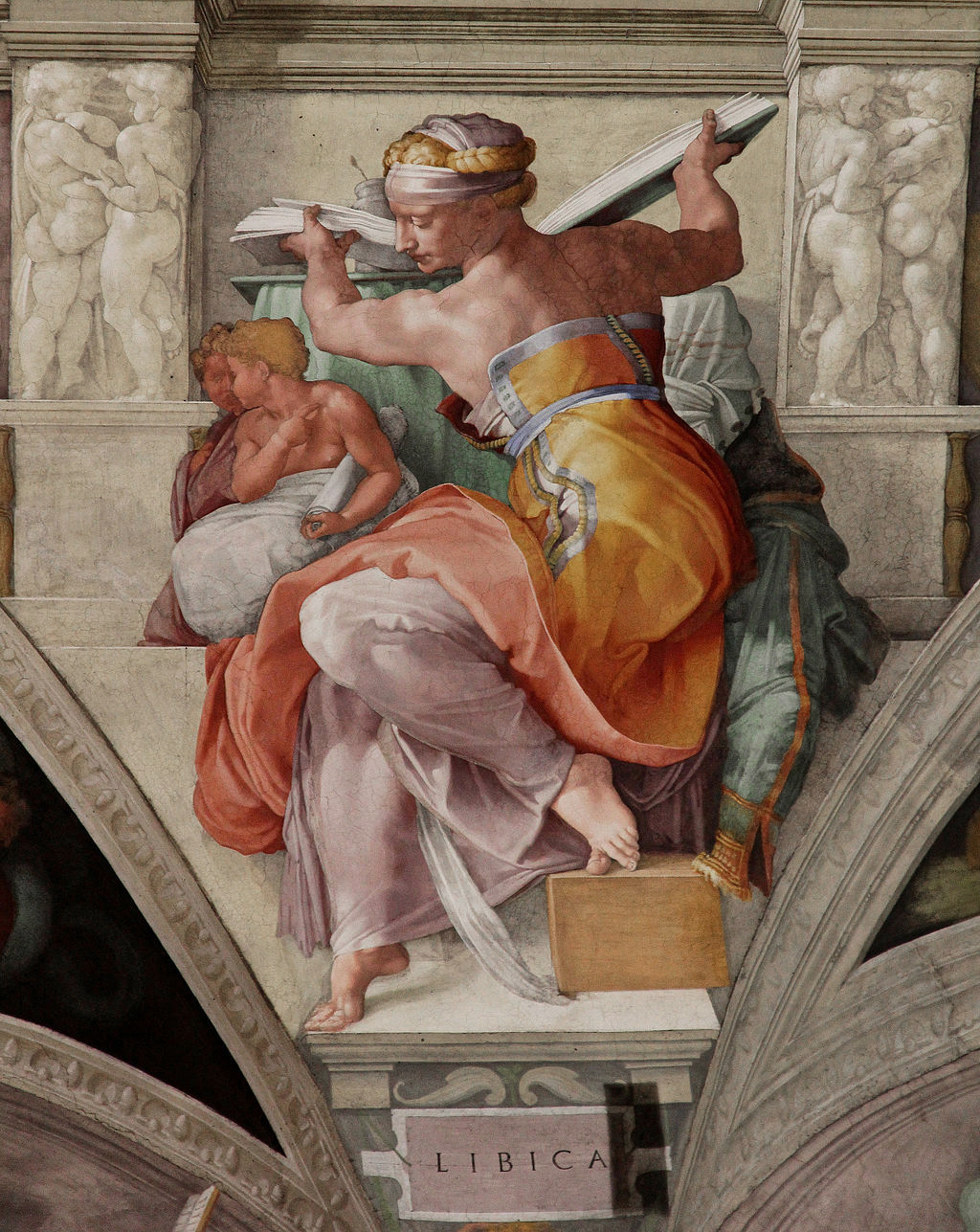
Michelangelo, Libyan Sibyl, c. 1511, fresco, part of the Sistine Chapel ceiling (Vatican Museums; photo: Jörg Bittner Unna, CC BY 3.0)
Michelangelo, Libyan Sibyl, c. 1511, fresco, part of the Sistine Chapel ceiling (Vatican Museums


File:Michelangelo, Fall and Expulsion from Garden of Eden 00.jpg
Michelangelo, Temptation and Expulsion, 1508-1512, sistine chapel ceiling. 


Saturday, September 5, 2026

Homework for Week 4&5

The Art and Artists of the Italian Renaissance 1400-1700


Next-- we dive into the Italian Rennaissance. It's impossible to know too much about this time because that time and place established: 
  1. what art history is
  2. the definitions of art, artists, modernism, and illusionism  that we rely on today,
  3. classical compositional forms, which define the ways people study in conservatories,
  4. the foundations of how we look at and talk about painting, sculpture, and architecture, 
  5. a set of works and ideas that govern many people's definition of excellence today, and more. 
There are three introductory essays that will set up our discussion of Renaissance Art in Italy on Sept. 10, 14, and 17. So you have a lot of reading for the 10th but very little for the 14th and 17th. 

You might consider reading straight through them for the 10th, then go back to skim aspects parts you want to remember in preparation for the 14th and 17th. 

Then, I assign each of you two key works to study in preparation to share your learning about them on the 14th and 17th.  Please be ready with those on the 14th.  If Smarthistory links take you to a video, note that there are dropdown menus at the bottom of the post that offers a transcript, artwork facts, and lots of photos. You can choose to look for the works in museum sites, books in our library, art historical materials online, and more-- in other words you don't have to use the sites I suggest.  I will insert links for everyone later this weekend, but you're welcome to just go ahead and search on your own if you're ready to embark. 

Betsy: Giotto, Scrovegni Chapel frescos Annunciation and Lamentation; Michelangelo, Sisting Chapel Ceiling

Aidan Ghiberti, Gates of Paradise,  (Aidan you just get one work because it has so many elements to consider it should count as several! (web gallery of art- alternative reading) 

Bella Botticelli, Birth of Venus  or here & Titian, Venus of Urbino or here


Thursday, September 3, 2026

Mother, Dictator, Monster? Portugal's Empirial Reign

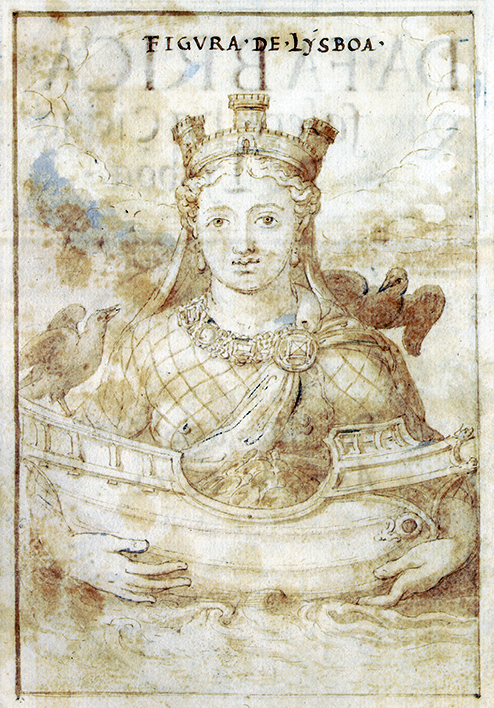
Francisco de Holanda, Allegorical Image of Lisbon, 1571, pencil on paper, in Francisco de Holanda, A Fábrica que Falece à Cidade de Lisboa (1572)

Francisco de Holanda, Allegorical Image of Lisbon, 1571, pencil on paper, in Francisco de Holanda, A Fábrica que Falece à Cidade de Lisboa (1572)

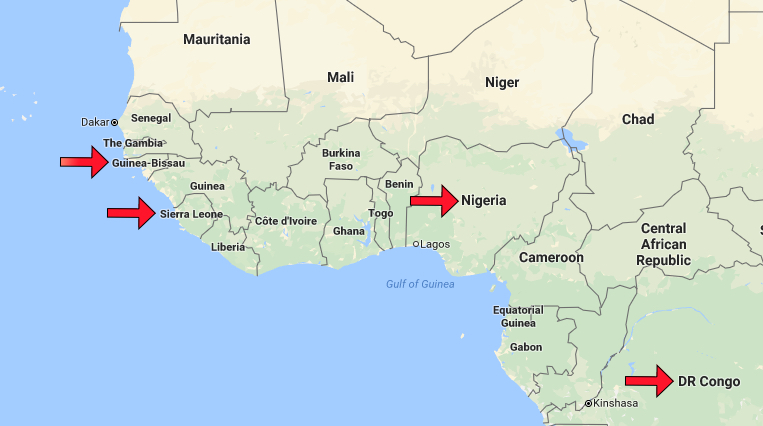
Portugal, Iberian Peninsula, Europe 1400-1800, Benin, West Africa 1400-20th c., England, Great Britain, Europe, late 19th & early 20th c

Portuguese Empire; Portugal and Age of Discovery? Age of Enlightenment? Colonial Period?


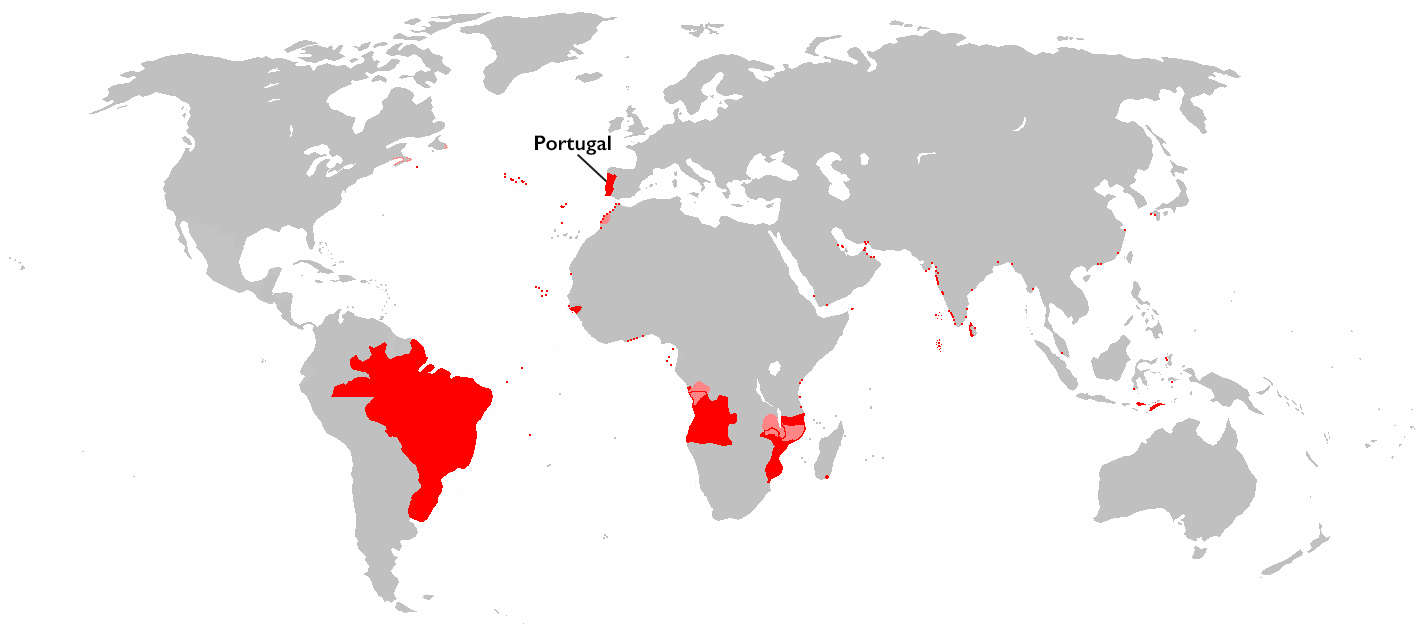
What do you notice about the map below?


map portuguese empire
Map Source: wikipedia


No photo description available.

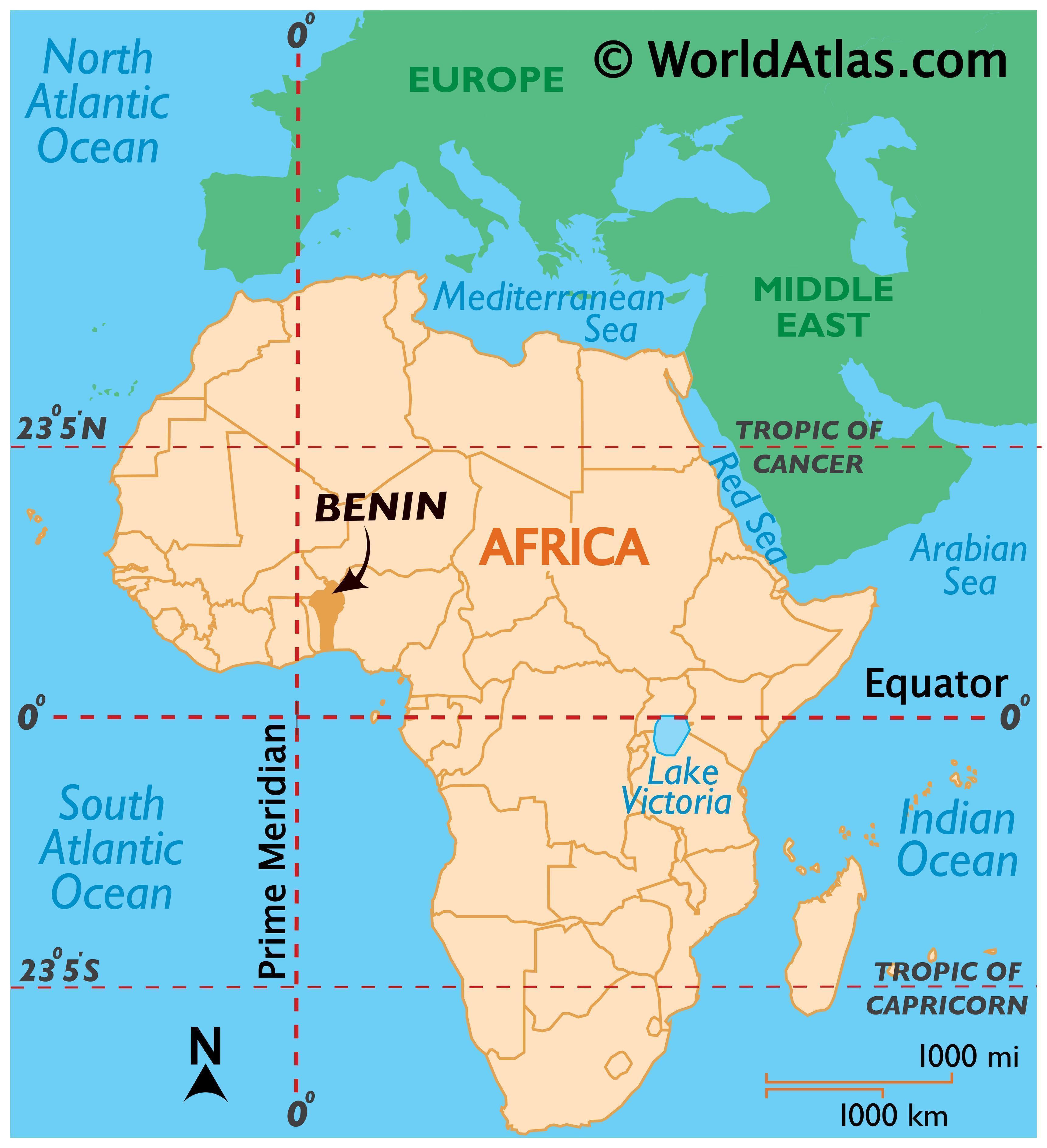
Portugal is about the size of Maine or Indiana. Benin is about 3x as large (112,000 sq miles compared to 35,000) and is about the size of Ohio or Pennsylvania. (NC is about 53,000 sq miles.)


What do you notice about the map below? 


Benin Maps & Facts - World Atlas
Benin locator- c. 16th-17th c
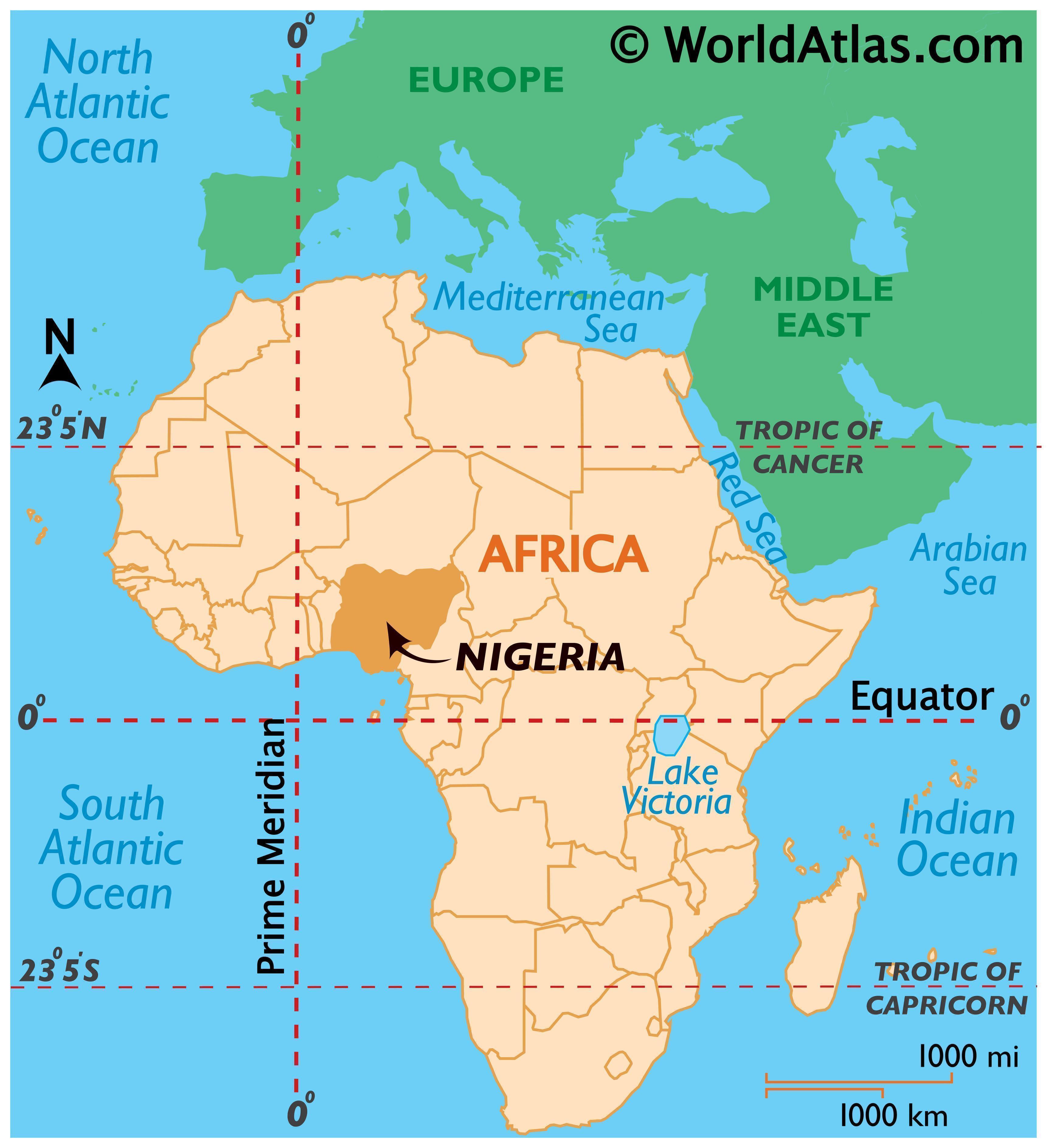
What do you notice about oceans? 


Nigeria Maps & Facts - World Atlas
Nigeria locator-- historic Kingdom of Benin is inside present-day Nigeria. Tezas is about 36% smaller than Nigeria. US is 11 x larger than Nigeria. 

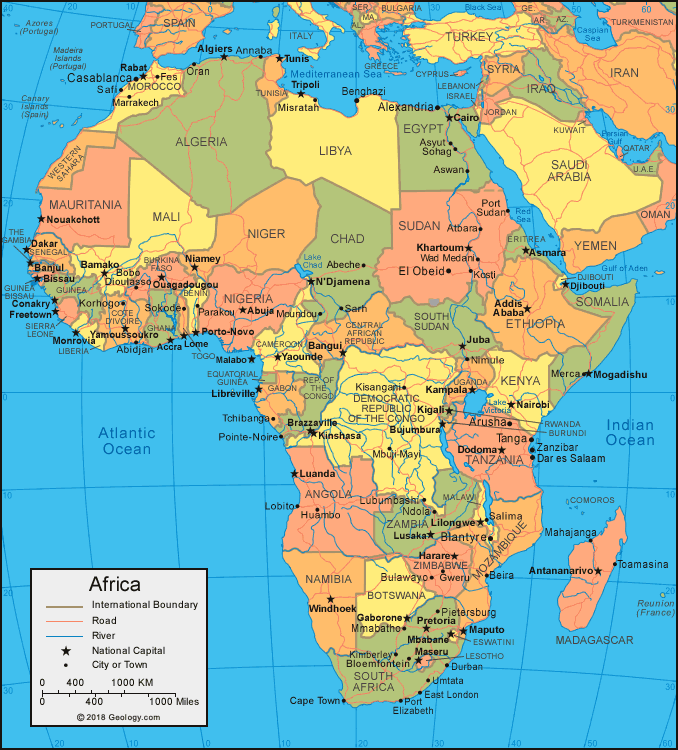
Africa Map and Satellite Image
Current Political Map of Africa
r/europe - a map of the world with different countries/regions
Map of the greatest extent of the portuguese empire


r/MapPorn - Comprehensive map of the British Empire - its colonies, territories, protectorates and more [OC]
map of greatest extent of british empire

Noticing: scribble indiv, then share regarding the sculpture or statue below: 
Brass figure of a Portuguese soldier holding a musket, 17th century C.E., Benin, Nigeria, brass, 43 x 20 x 18.5 cm © Trustees of the British Museum
Brass figure of a Portuguese soldier holding a musket, 17th century C.E., Benin, Nigeria, brass, ~18" tall (photo © Trustees of the British Museum)


Each look up definition of one term

Iberian Union

confraternity

evangelization

cultural entanglement

"Age of Exploration"

relief- bas-relief/low-relief, haut-relief/high relief


When Portuguese merchants or consumers were interacting with artists in other continents, who was making decisions about an artwork’s materials, iconography, and design?

Who would have been viewing and using an artwork or architectural structure? How would different audiences have understood the objects?


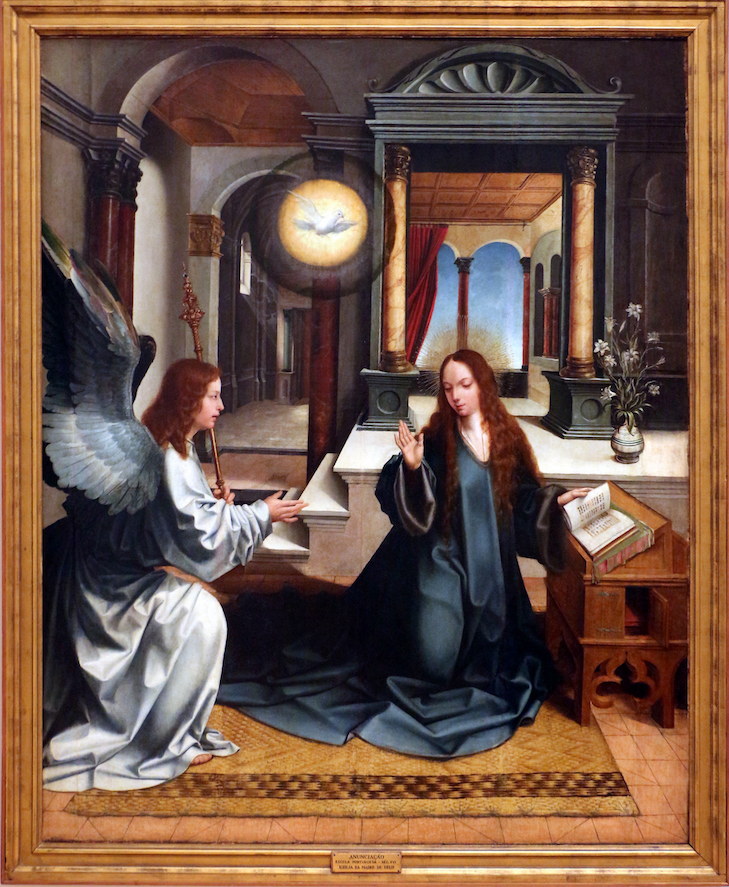
Attributed to Jorge Afonso’s workshop, Annunciation, 1515, oil on panel (Museu Nacional de Arte Antiga, Lisbon; photo: Sailko, CC0)

Attributed to Jorge Afonso’s workshop, Annunciation, 1515, oil on panel (Museu Nacional de Arte Antiga, Lisbon)


Observations: formal/compositional? content? iconography? subject? emotion? style? interpretation? 

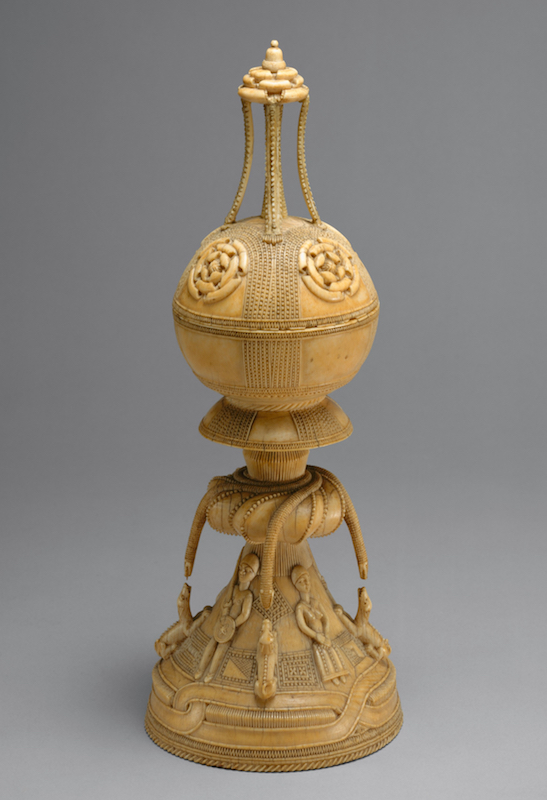
Lidded Saltcellar, Sierra Leone, Sapi-Portugese, 15th-16th century, ivory, 29.8 cm high (The Metropolitan Museum of Art)
Hybridity: Lidded Saltcellar, Sierra Leone, Sapi-Portugese, 15th–16th century, ivory, 29.8 cm high (The Metropolitan Museum of Art)

 Consider: changing purpose of manufacture... consider: collecting. Consider: hybridity. Consider: exoticism

Map

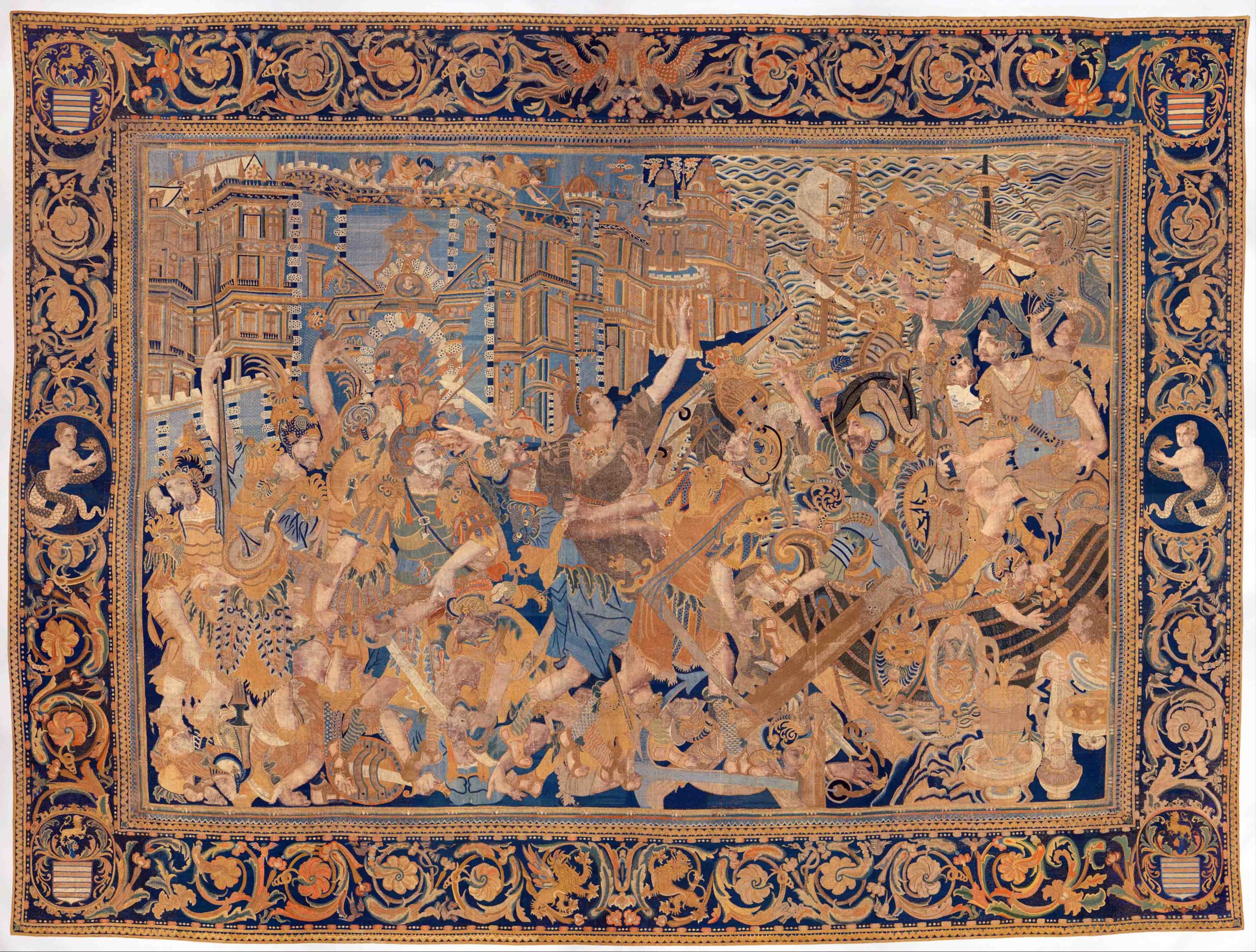
The Abduction of Helen, from a set of the story of Troy, first half of the 17th century, cotton, embroidered with silk and gilt-paper-wrapped thread, pigment, from China, for the Portuguese market 3.6 x 4.8 m (The Metropolitan Museum of Art)
A tapestry made in China for the Portuguese market that shows a scene from the story of Troy. The Abduction of Helen, from a set of the story of Troy, first half of the 17th century, cotton, embroidered with silk and gilt-paper-wrapped thread, pigment, from China, for the Portuguese market 3.6 x 4.8 m (The Metropolitan Museum of Art)


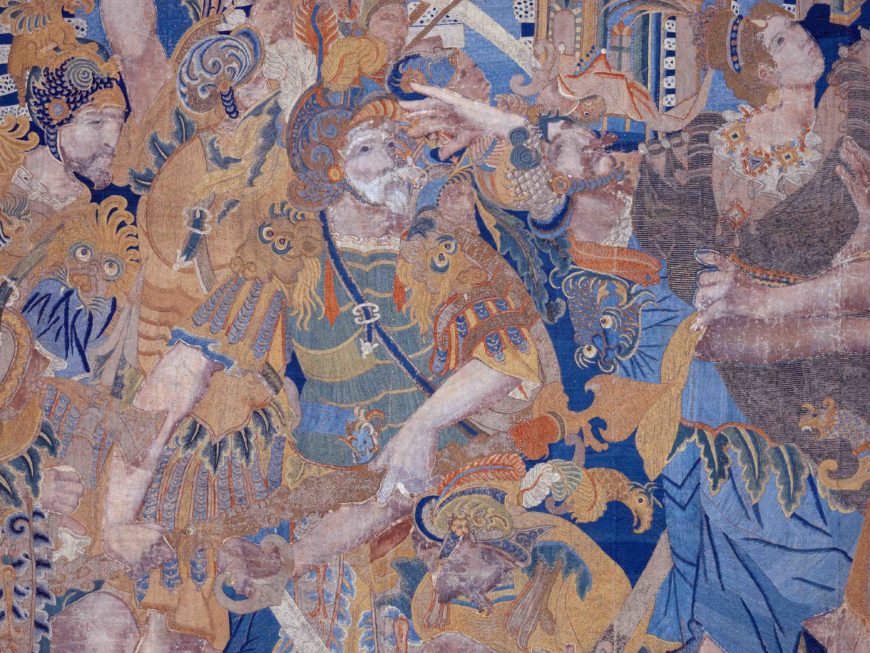
Detail of Menelaus, The Abduction of Helen, from a set of the story of Troy, first half of the 17th century, cotton, embroidered with silk and gilt-paper-wrapped thread, pigment, from China, for the Portuguese market 3.6 x 4.8 m (The Metropolitan Museum of Art)

Detail of Menelaus, The Abduction of Helen, from a set of the story of Troy, first half of the 17th century, cotton, embroidered with silk and gilt-paper-wrapped thread, pigment, from China, for the Portuguese market 3.6 x 4.8 m (The Metropolitan Museum of Art)

What else was going on in the world? 1st half of 17th c-- early 1600's 
In China? 
In Benin? 
In Portugal? 
In USA?
In Italy? 

What does the tapestry tell us about cultural entanglements? 
"Like the overlapping, twisting bodies of the warriors that are challenging to make out on the tapestry, so too is it difficult to categorize this tapestry by place, style, or artists. Is it renaissance or baroque art? Chinese art? On a site like Smarthistory, where do we locate this tapestry? Transcultural objects will continue to push art historians to rethink how we categorize art, especially since most of those categories were developed without complex, culturally entangled works like the Abduction of Helen in mind."


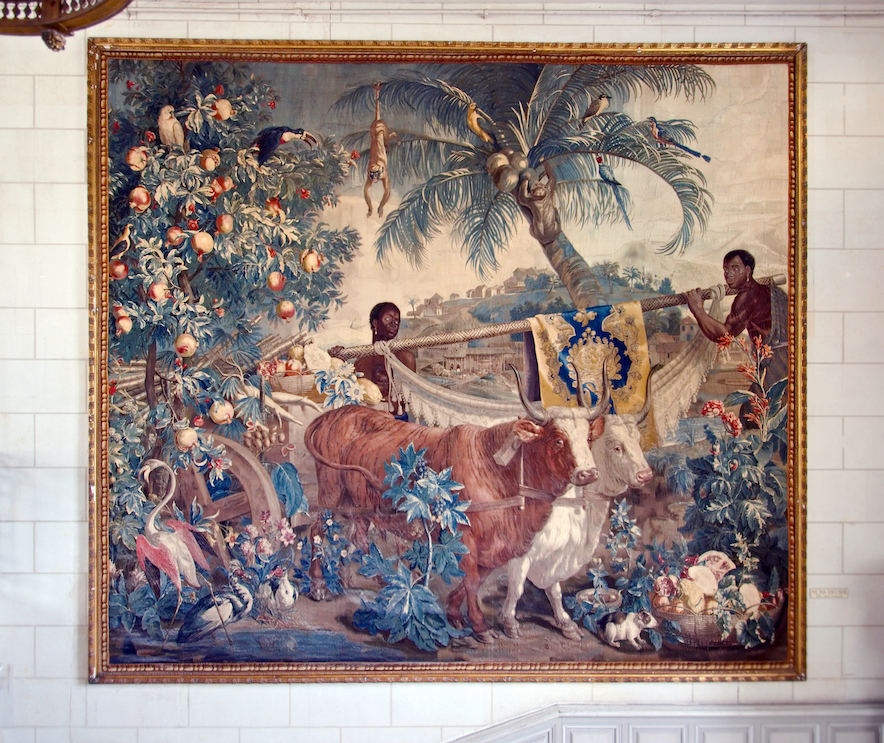
How can active description of form and content in the image below build understanding of cultural entanglements? How do they help build understanding of the questions raised by the text? When Portuguese merchants or consumers were interacting with artists in other continents, who was making decisions about an artwork’s materials, iconography, and design? Who would have been viewing and using an artwork or architectural structure? How would different audiences have understood the objects?


Desportes Alexandre François (designer), Gobelin Workshop (weavers), after cartoons by Albert Eckhout and Frans Post, “The two bulls,” c. 1734, tapestry, Château de Valençay

Desportes Alexandre François (designer), Gobelin Workshop (weavers), after cartoons by Albert Eckhout and Frans Post, “The two bulls,” c. 1734, tapestry, Château de Valençay (photo: Frédéric Bisson, CC BY 2.0)

plaque | British Museum
Mudfish Plaque, Benin Kingdom, present-day Nigeria, Edo People, 16th-17th centuryRelief plaque, lost-wax cast in brass. 


plaque | British Museum
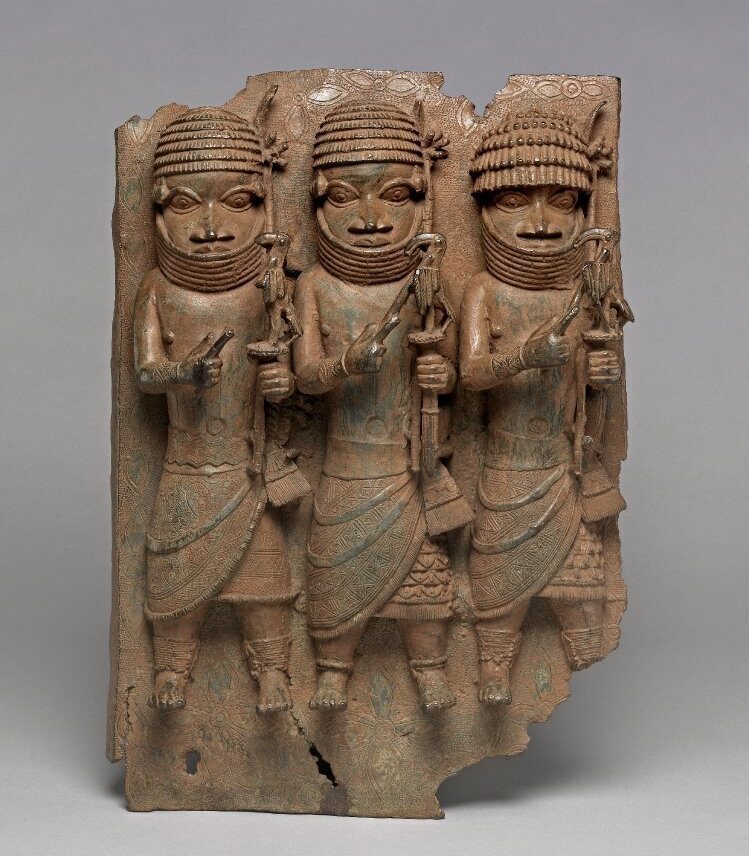
Bronze relief of an Oba, Edo Peoples, 16th-17th centuries, ~20" high, made in Benin City for the Oba's palace, now in the British Museum. British Museum Contextualization of the Plaques. 


Plaques from Benin City on display at the British Museum (photo: Steven Zucker, CC BY-NC-SA 2.0)

 Benin Plaques if you wish, here’s more on the looting of the plaques


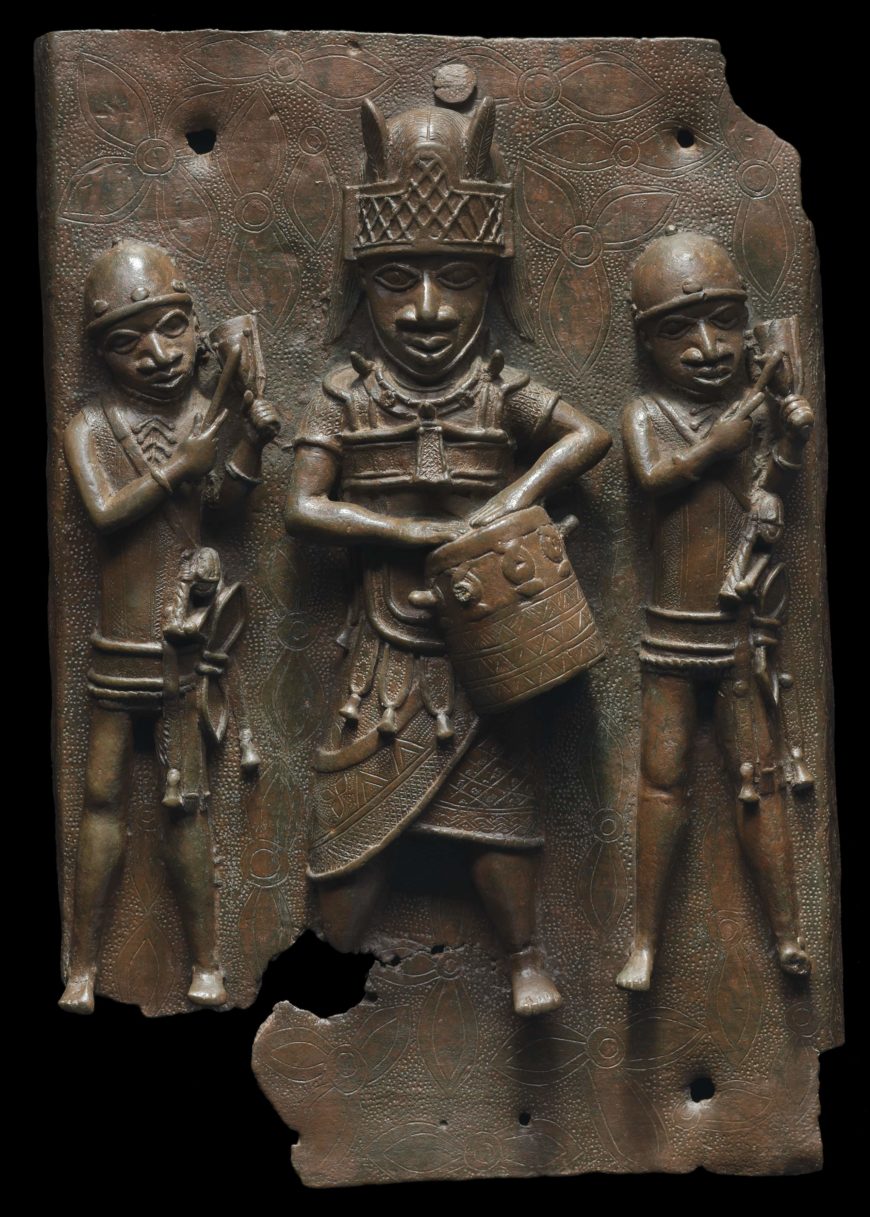
Artist Unidentified, Relief plaque showing a dignitary with drum and two attendants striking gongs, c. 1530-1570, copper alloy (Robert Owen Lehman Collection, Courtesy Museum of Fine Arts, Boston)

Artist Unidentified, Relief plaque showing a dignitary with drum and two attendants striking gongs, c. 1530-1570, copper alloy (Robert Owen Lehman Collection, Courtesy Museum of Fine Arts, Boston)

Detail of relief plaque showing two officials with raised swords, showing the high relief of the bodies and fully-free swords (photo: Steven Zucker, CC BY-NC-SA 4.0)

Detail of relief plaque showing two officials with raised swords, showing the high relief of the bodies and fully-free swords (photo: Steven Zucker, CC BY-NC-SA 4.0)


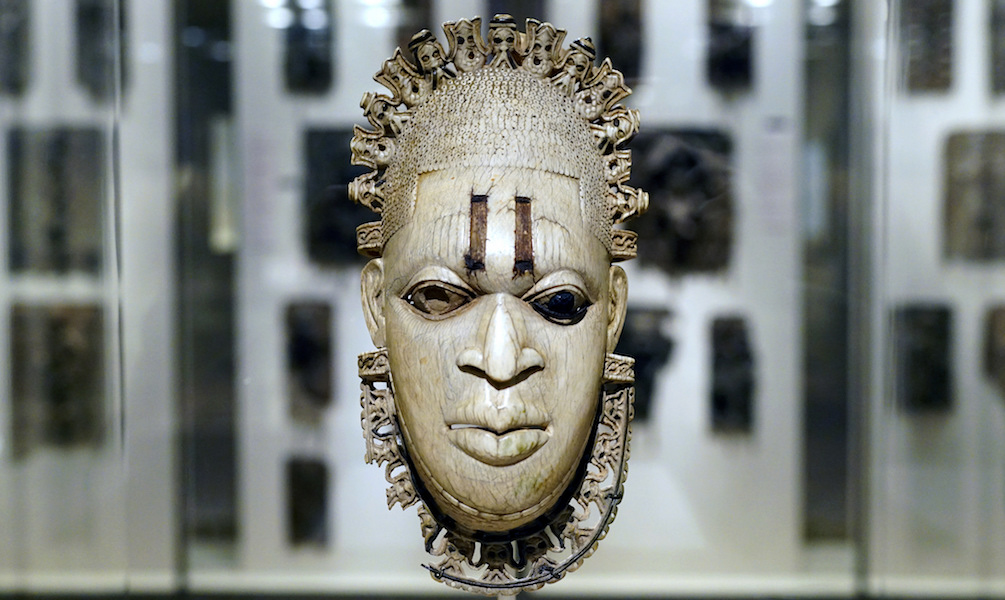
Queen Mother Pendant Mask (Iyoba), 16th century, Edo peoples, Court of Benin, Nigeria, ivory, iron, copper, 23.8 x 12.7 x 8.3 cm (The Metropolitan Museum of Art; photo: Steven Zucker, CC BY-NC-SA 2.0)
4. Benin Ivory Mask if you wish, here’s more about the mask) Unknown Artist from the Igbesanmwari workshop, Portrait of Iyoba (Queen) Idiya, Edo People, Kingdom of Benin,  16th c, ivory (would previously have had inlays of coral and metals, 9" tall, now in the British Museum.


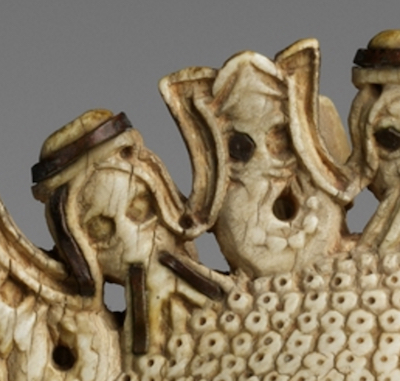
Detail, Queen Mother Pendant Mask (Iyoba), 16th century, Edo peoples, Court of Benin, Nigeria, ivory, iron, copper, 23.8 x 12.7 x 8.3 cm (The Metropolitan Museum of Art)

The motifs of the mudfish and Portuguese traders are both "associated with the Oba and his counterpart, the sea god Olokun. The mudfish is a creature that lives both on land and in water, and a symbol of the king’s dual nature as both human and divine. Similarly, the Portuguese, as voyagers from across the sea, may have been seen as denizens of Olokun’s realm. Like the sea god, they brought great wealth and power to the Oba." (from Smarthistory)

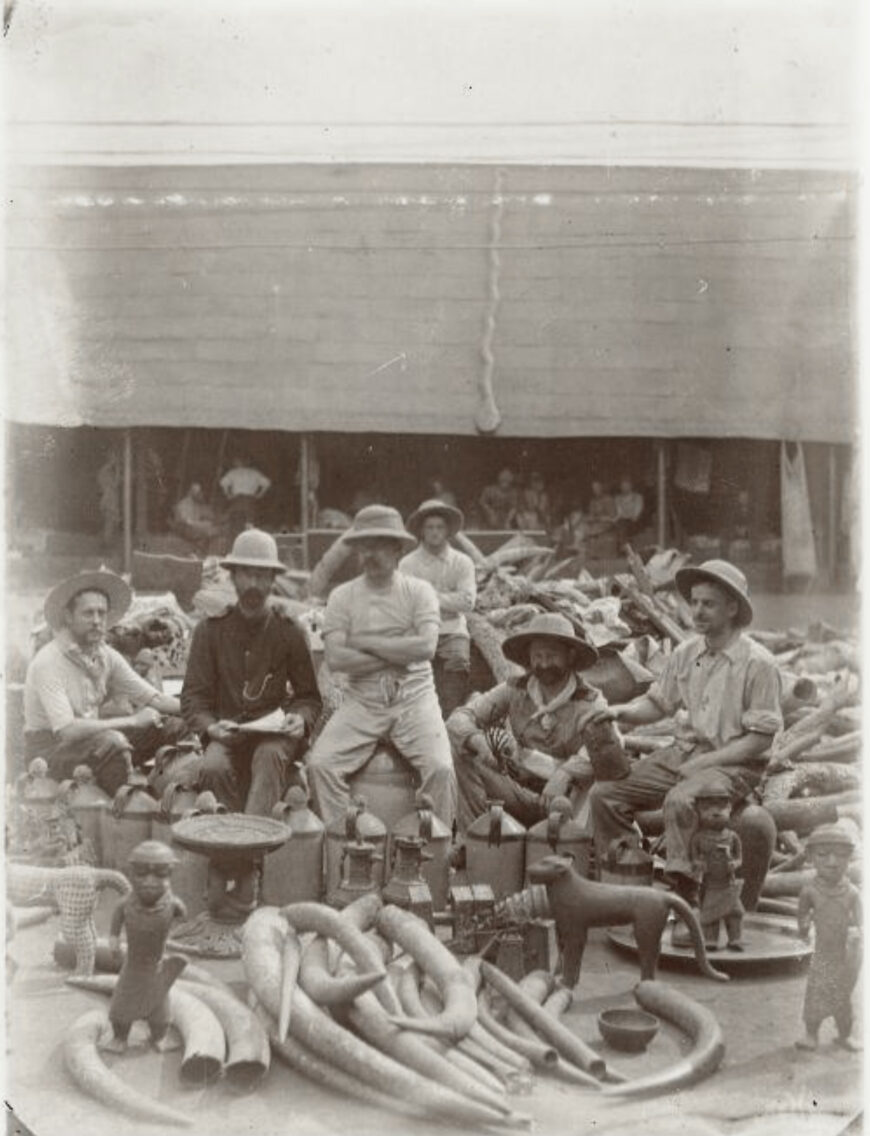
Photographer unidentified, members of the British expedition to Benin City with objects from the royal palace, 1897, gelatin silver print, 16.5 x 12 cm (© Trustees of the British Museum)
British Soldiers/Looters after the 1897 Punitive Expedition; justified by Phillips Expedition which in turn Phillips justified on Oba Ovonamwen's slowing of trade of certain commodities, including palm kernals which the British wanted for producing oil
Artist unidentified, Relief plaque, 16th–17th century, Benin City, Nigeria, brass, 46.5 x 37.5 x 11 cm (© Trustees of the British Museum)
Artist unidentified, Relief plaque, 16th–17th century, Benin City, Nigeria, brass, 18" tall


"Calls for the return of the Benin “Bronzes” have been issued since 1936, when Oba Akenzua II made the first formal request to the British Museum. G.M. Miller instructed the British Museum to return to Oba Akenzua II three items that he had loaned previously: “two coral crowns and a coral bead garment.” [12] Today, museums, galleries, and other institutions that have Benin “Bronzes” in their collections are grappling with what to do with them in the face of mounting diplomatic pressures, especially within the last decade, to repatriate or restitute them. Dan Hicks, who is working to return the Benin “Bronzes” in the Pitt Rivers Museum, makes clear, “the arrival of loot into the hands of western curators, its continued display in our museums and its hiding-away in private collections, is not some art-historical incident of ‘reception’, but an enduring brutality that is refreshed every day that an anthropology museum like the Pitt Rivers opens its doors.” [13]

Prince Gregory Akenzua, one of the great-grandsons of Oba Ovonramwen, asserts, “[the] artwork can be said to represent the history of the Benin people for centuries. It was taken from us. It was like ripping pages out of our history.” [14]" from Smarthistory

Monday, August 31, 2026

Art During the Qing Dynasty: Tradition and Innovation

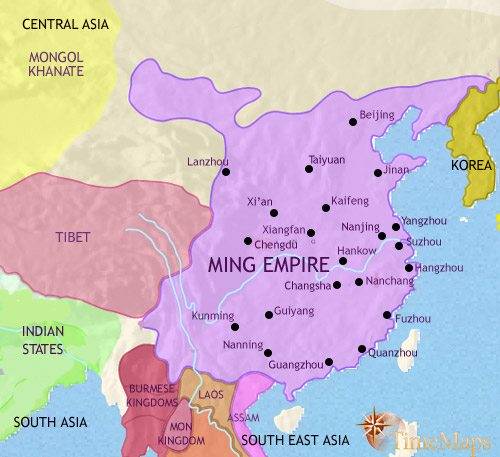
 In the centuries before Qing Rule, the Ming Dynasty controlled China for three centuries from 1368-1644, having taken over after the a series of natural disasters unsettled the particularly brutal Yuan Dynasty of Mongolian decent. That destabilization made it possible for Zhu Yuanzhang to lead an overthrow of the Yuan. Zhu was the only emperor of China with peasant roots. The dynasty he established, remained in power for 276 years.  Map of China, 1453: Under the Ming Dynasty | TimeMaps

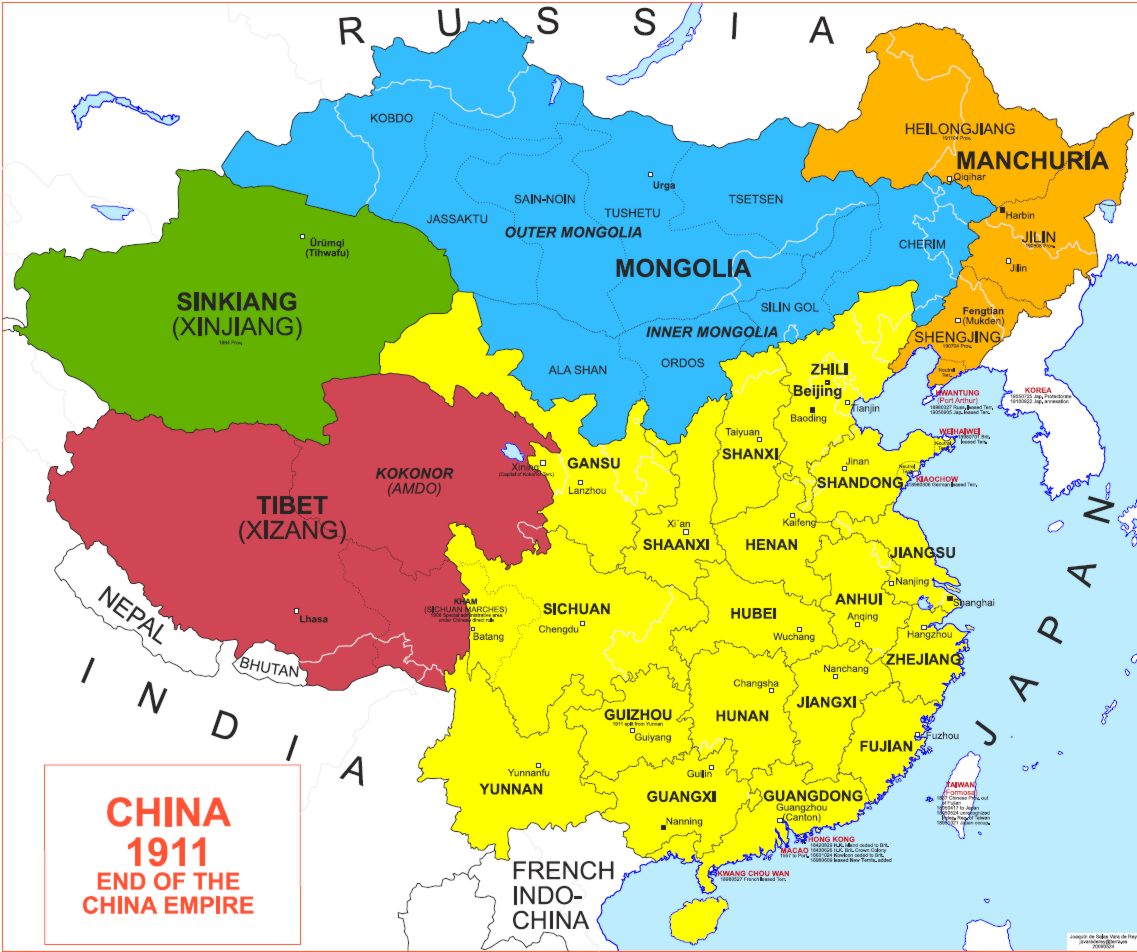
In the 1620's and 30's, a China wracked by peasant uprisings set off a new period of instability which allowed Manchu invaders from the northeast to raid China and take power following a violent transition. The Manchus established the Qing Dynasty which remained in power for almost 300 stable, prosperous years marked by robust artistic productivity which ended with the foundation of the Chinese Republic in 1912. 
1911ChinaTRZ.jpg
From Reframing Art History: 

Key questions to guide your reading

How did the Manchu court use art to convey power in a multiethnic empire?

How did the arts of Qing China respond to the arts in other world areas, such as Europe?

Which aesthetic traditions did artists engage with in the Jiangnan region?
 
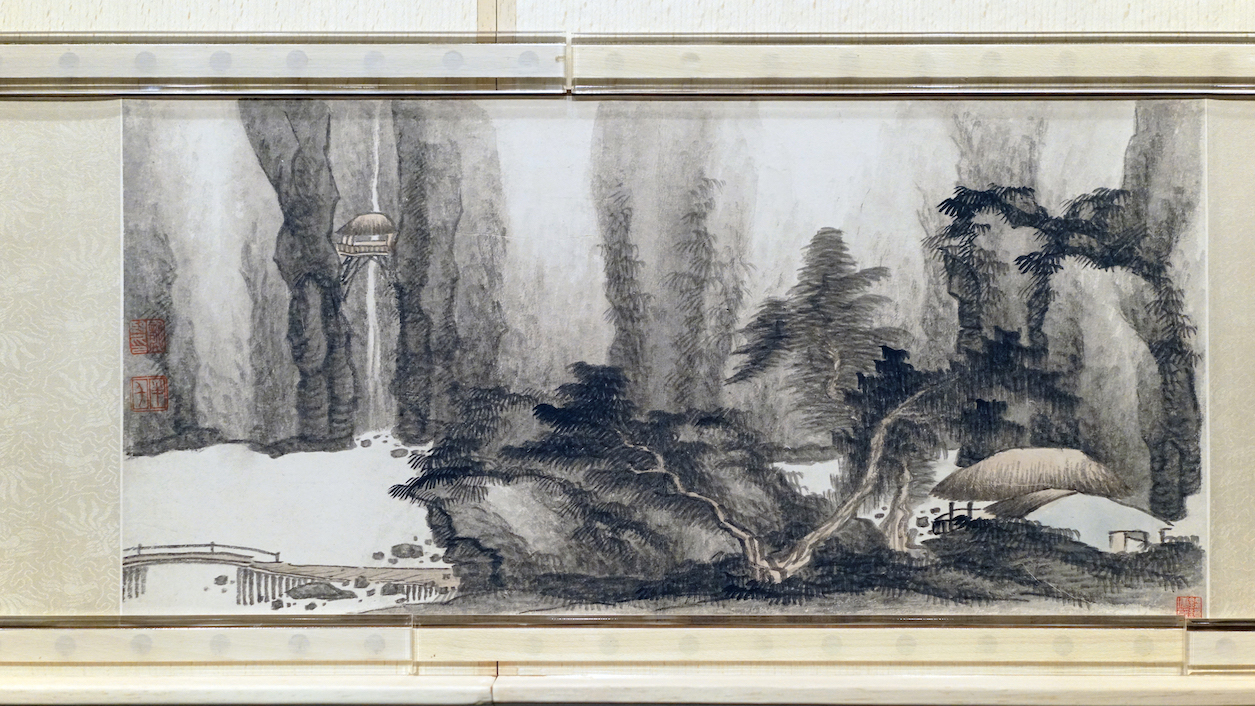
Gong Xian, one album leaf from Eight Views of Landscape, 1684, Qing Dynasty, handscroll, ink on paper (Shanghai Museum)


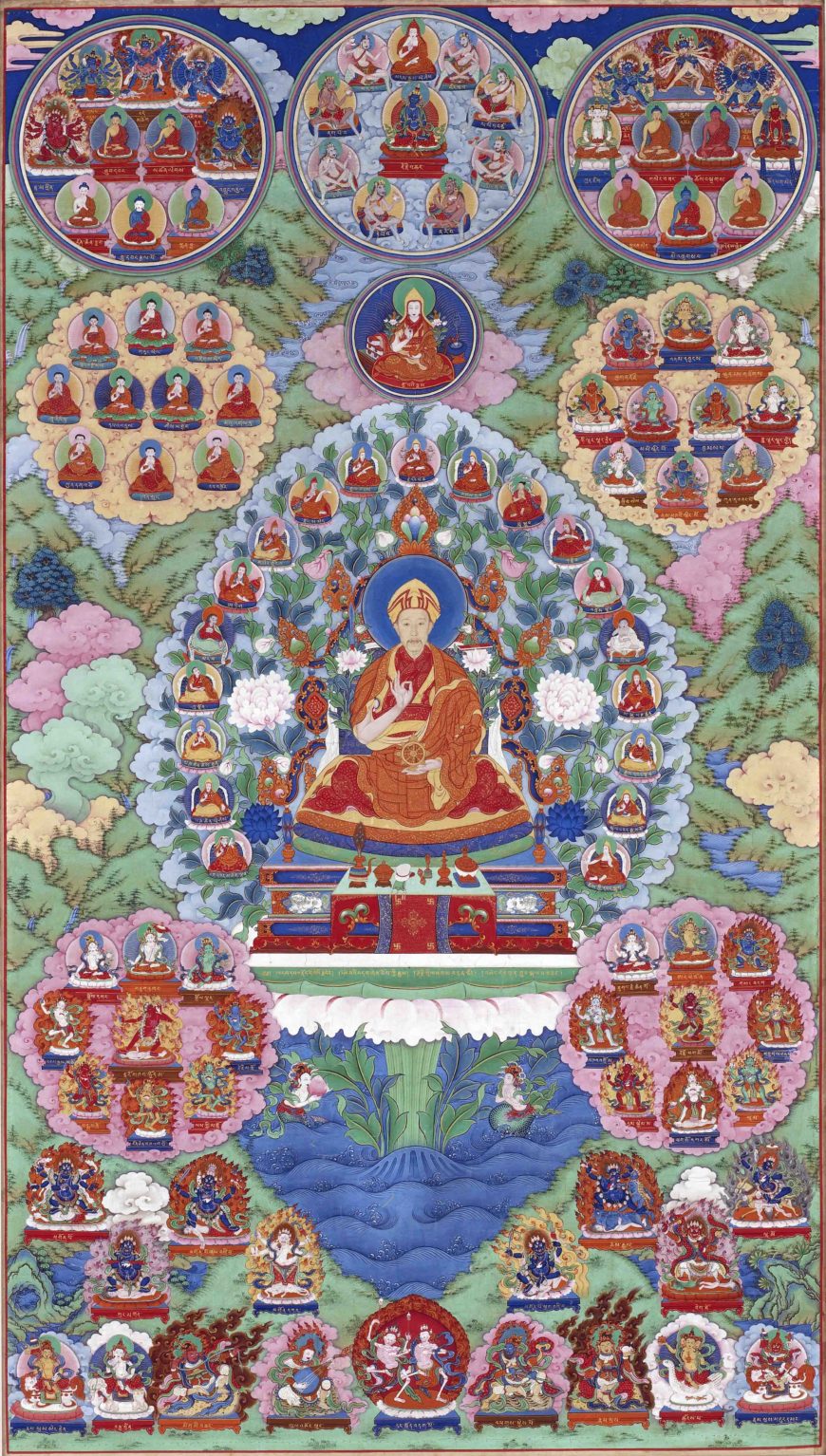
Imperial workshop, with emperor's face by Giuseppe Castiglione, The Qianlong Emperor as Manjushri, the Bodhisattva of Wisdom, mid-18th century (Qing dynasty, Qianlong reign, China), ink, color, and gold on silk, 113.6 x 64.3 cm (Freer Gallery of Art, Smithsonian Institution, Washington, D.C.: Purchase—Charles Lang Freer Endowment and funds provided by an anonymous donor, F2000.4)
Imperial workshop, with emperor’s face by Giuseppe Castiglione, The Qianlong Emperor as Manjushri, the Bodhisattva of Wisdom, mid-18th century (Qing dynasty, Qianlong reign, China), ink, color, and gold on silk, 113.6 x 64.3 cm (Freer Gallery of Art, Smithsonian Institution, Washington, D.C.: Purchase—Charles Lang Freer Endowment and funds provided by an anonymous donor, F2000.4)


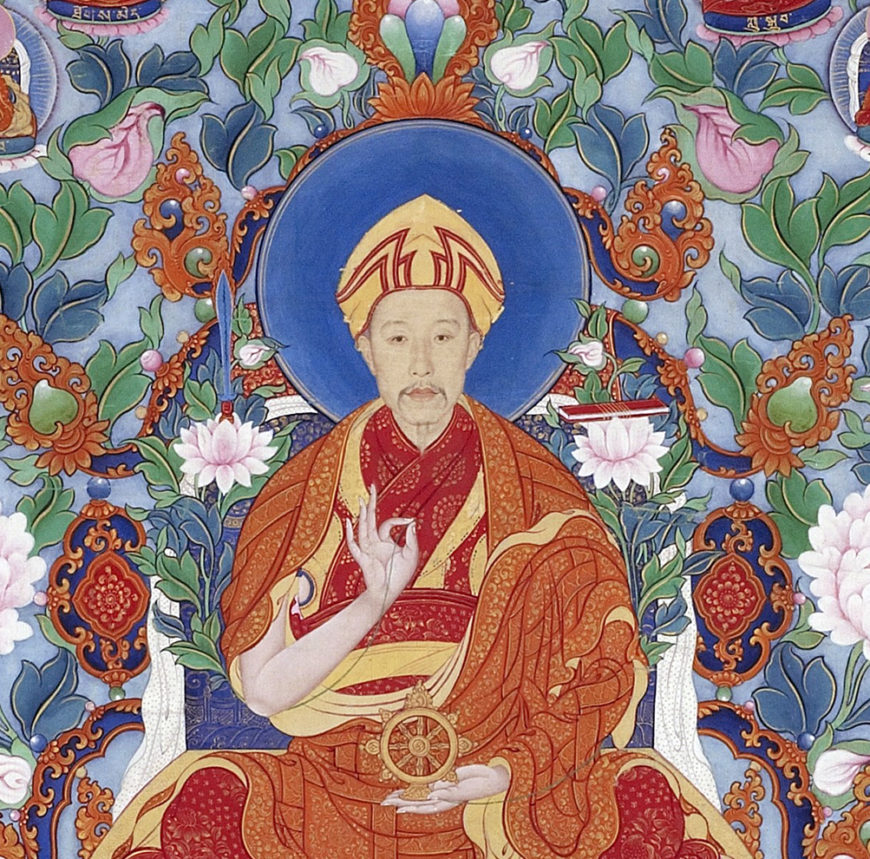
Emperor (detail), imperial workshop, with emperor's face by Giuseppe Castiglione, The Qianlong Emperor as Manjushri, the Bodhisattva of Wisdom, mid-18th century (Qing dynasty, Qianlong reign, China), ink, color, and gold on silk, 113.6 x 64.3 cm (Freer Gallery of Art, Smithsonian Institution, Washington, D.C.: Purchase—Charles Lang Freer Endowment and funds provided by an anonymous donor, F2000.4)


Mosaic of Christ Pantocrator in the Hagia Sophia, Istanbul. 1261
Emperor’s face painted by Giuseppe Castiglione (1688–1766) Imperial workshop, The Qianlong Emperor as Manjushri, the Bodhisattva of Wisdom, Qing dynasty, Qianlong reign, mid-18th century, ink, color, and gold on silk, China, 113.6 x 64.3 cm (see description of this painting on smarthistory)


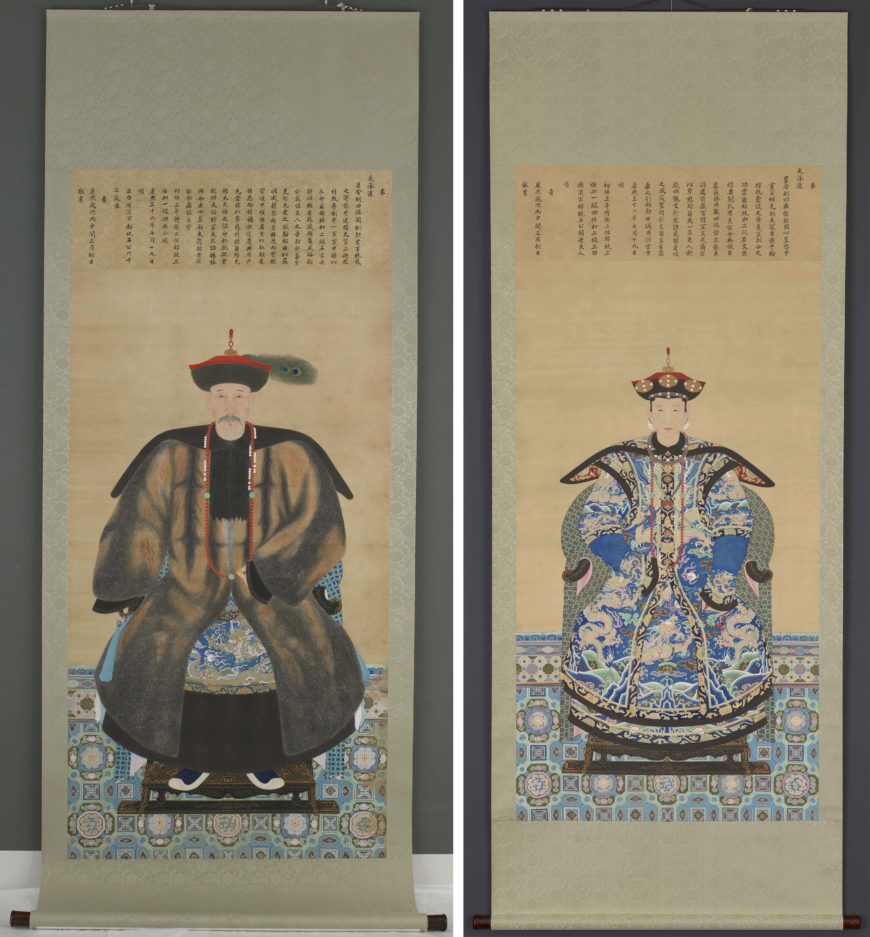
Left: Portrait of Shi Wenying, Qing dynasty, 1644–1911, ink and colors on silk, China, 210.9 x 113.7 cm (Arthur M. Sackler Gallery, Smithsonian Institution, Washington, DC: Purchase — Smithsonian Collections Acquisition Program and partial gift of Richard G. Pritzlaff, S1991.120); right: Portrait of Lady Guan, Qing dynasty, Kangxi reign or later, mid 17th-early 18th century, ink and color on silk, China 343 x 145 cm (Arthur M. Sackler Gallery, Smithsonian Institution, Washington, DC: Purchase — Smithsonian Collections Acquisition Program and partial gift of Richard G. Pritzlaff, S1991.121)
Left: Portrait of Shi Wenying, Qing dynasty, 1644–1911, ink and colors on silk, China, 210.9 x 113.7 cm (Arthur M. Sackler Gallery, Smithsonian Institution, Washington, DC: Purchase — Smithsonian Collections Acquisition Program and partial gift of Richard G. Pritzlaff, S1991.120); right: Portrait of Lady Guan, Qing dynasty, Kangxi reign or later, mid 17th-early 18th century, ink and color on silk, China, 343 x 145 cm
"ancestor portraits, which are formal, forward-facing portraits of deceased ancestors used for family worship. They each sit in a round-backed chair in a frontal and symmetrical pose. Matching chairs and carpets visually connect the portraits. The settings are otherwise blank, drawing our attention to the sitters."
File:Ebbo Gospels St Mark.jpg
St Mark, Ebbo Gospels, 815 
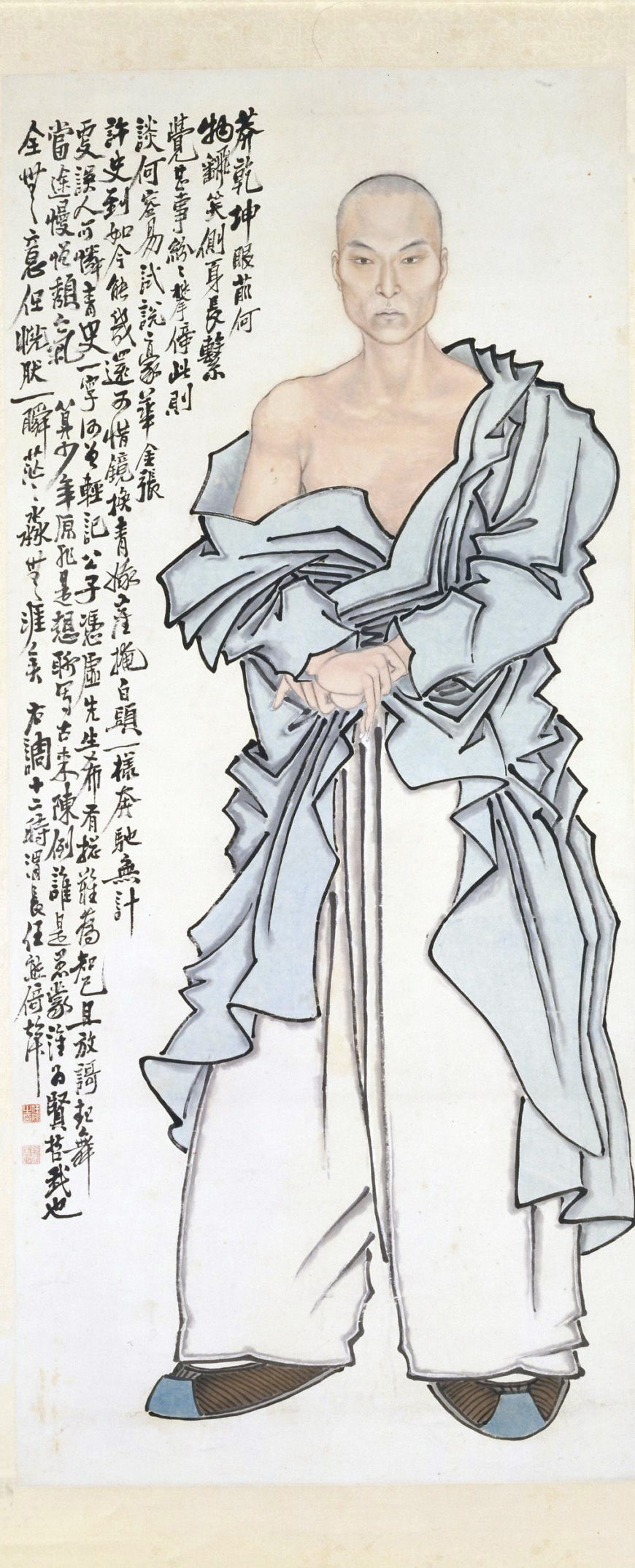
Ren Xiong (1823–57), Self-Portrait, Qing Dynasty, ink and colors on paper, 177.5 x 78.8 cm (Palace Museum, Beijing)
Ren Xiong (1823–57), Self-Portrait, c. 1850, Qing Dynasty, 


"His painting also offers a way for us to think about modernity in a global sense. Ren’s dramatic self-portrait indicates that he is not merely an artist concerned with his craft, but rather a man concerned with self-expression—of communicating his trauma amid a rapidly changing world. Ren painted his portrait before the fall of China’s last imperial dynasty (the Qing dynasty). His self-portrait is breathtaking and bold; it suggests that the artist saw himself as living in the eye of the storm—and taking a modern and self-aware stance. His confrontational manner can also be read as tormented, a representation that fits with what we know about his life and the tragic period in which he lived—civil war amid the rise of Shanghai as a cosmopolitan, international port city. "


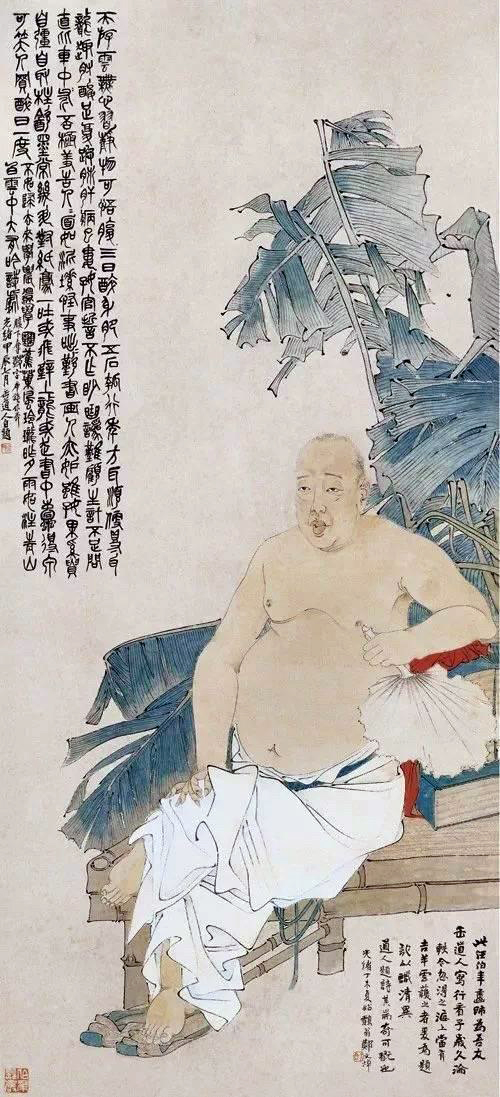
Ren Yi, Portrait of Wu Changshuo Enjoying the Cool Shade of Banana Palms. Hanging scroll: ink and color on paper, 129.5 x 58.9 cms. Zhejiang Provincial Museum, Hangzhou
Ren Yi, Portrait of Wu Changshuo Enjoying the Cool Shade of Banana Palms, 1888, hanging scroll: ink and color on paper, 129.5 x 58.9 cms.


"Buddhist Sage is a reminder that the most “Chinese” of Buddhist sects (Chan) was not only a meaningful part of the modern world, but was in its origins something brought to China from “the Western regions,” by a foreigner, the sage Bodhidharma. It shows how Wang Zhen’s art challenges simplistic categories, of “Eastern” and “Western”, and undermines any too-neat division of Republican China’s art into “traditional” and “modern.”"

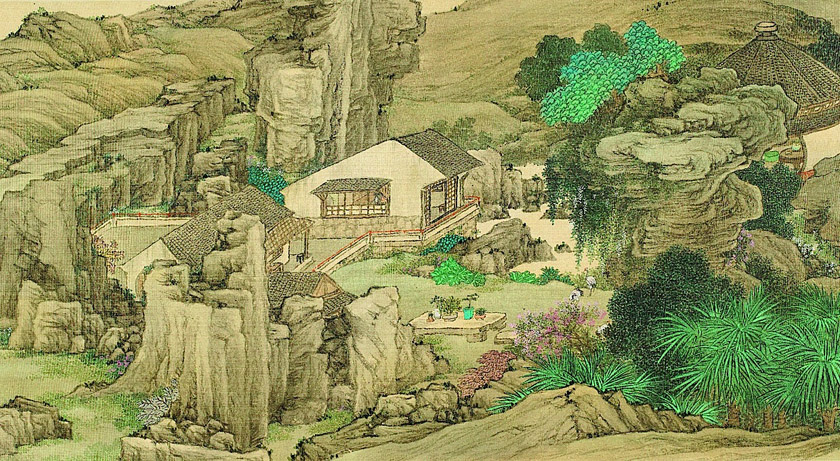
Ren Xiong (1823-1857) The Fan Lake Cottage 7 meters
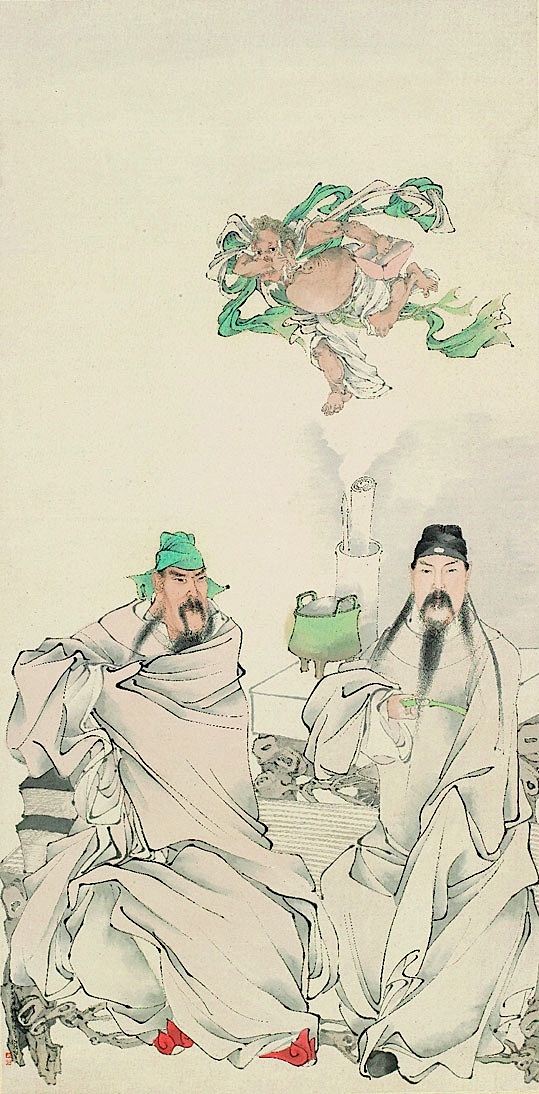
Ren Bonian (1840-1895). Wen Chang and Guan Yu 

Thursday, August 27, 2026

A Week of Losses

Dolly Parton photographed by Andy Warhol © Andy Warhol Foundation

 
Andy Warhol, Dolly Parton, 1985.


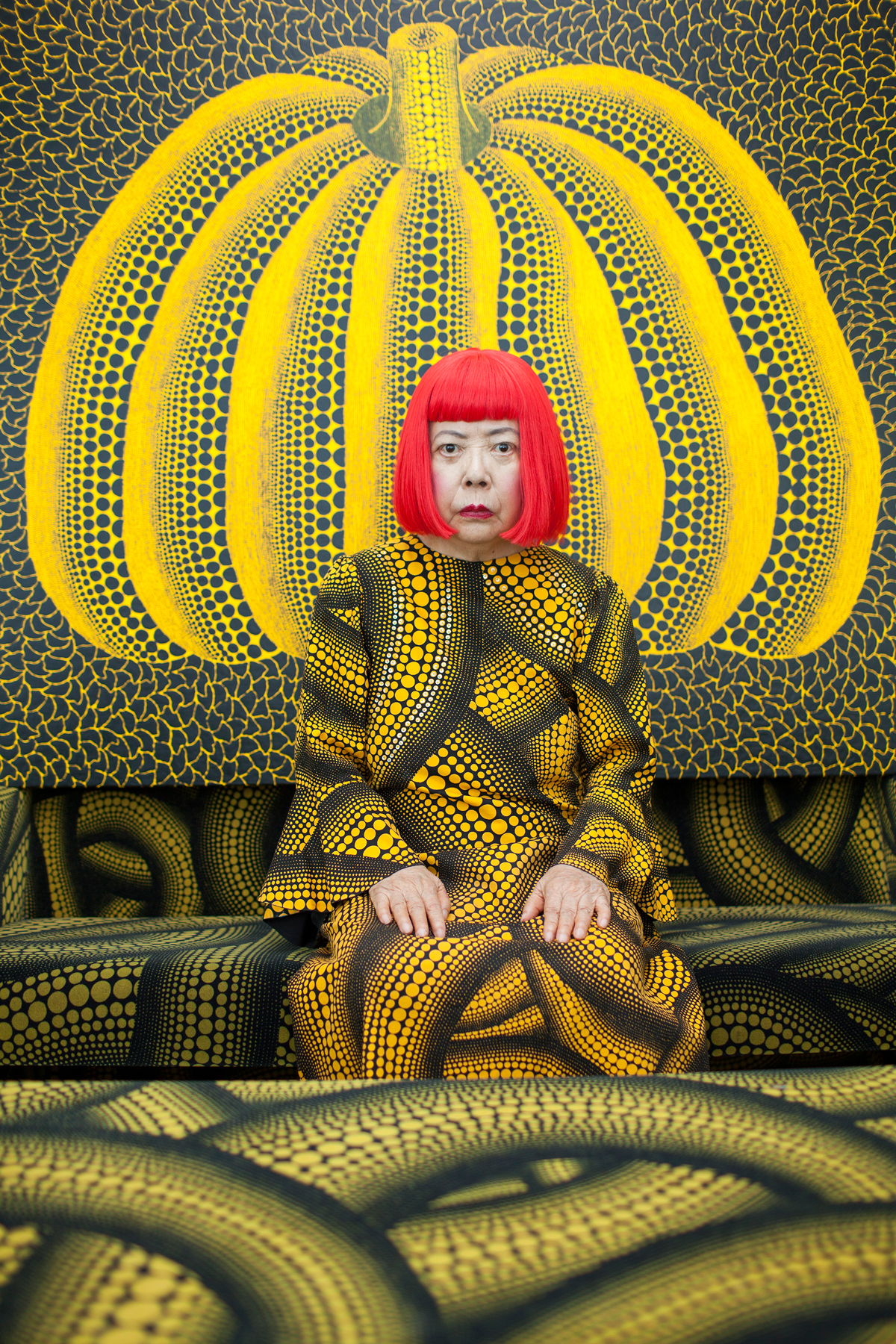
Yayoi Kusama & Pumpkins – What you should know
Yayoi Kusama
Watch This: KUSAMA'S SELF-OBLITERATION, a 1967 Film Portrait of Artist Yayoi  Kusama | Austin Film Society


Yayoi Kusama - IMDb


May be an image of textENTER-CURRY-OBIT-FILEPIC-ZUM