

 |
| The vast majority of early, settled civilizations developed in two regions: Mesoamerica and the Andes. Mesoamerican cultures include Zapotec, Toltec, Olmec, Maya, Aztec, Mixtec, Totonac, Teotihuacan, Huastec people, Purépecha, Izapa and Mazatec. Andean cultures include Inca, Caral-Supe, Wari, Tiwanaku, Chimor, Moche, Muisca, Chavin, Paracas, and Nazca. (There's a terrific brief intro to |
 |
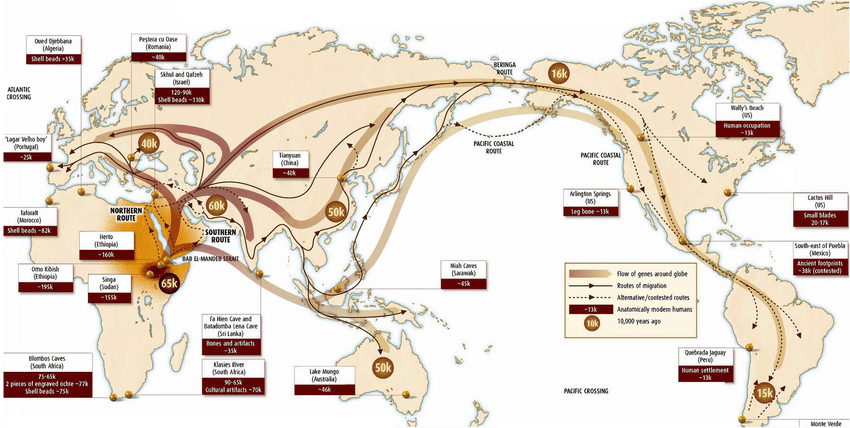
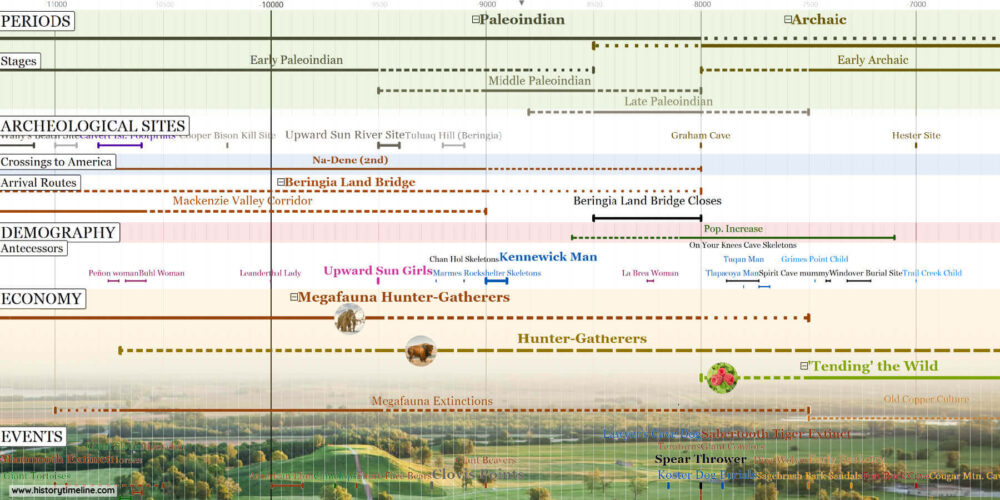
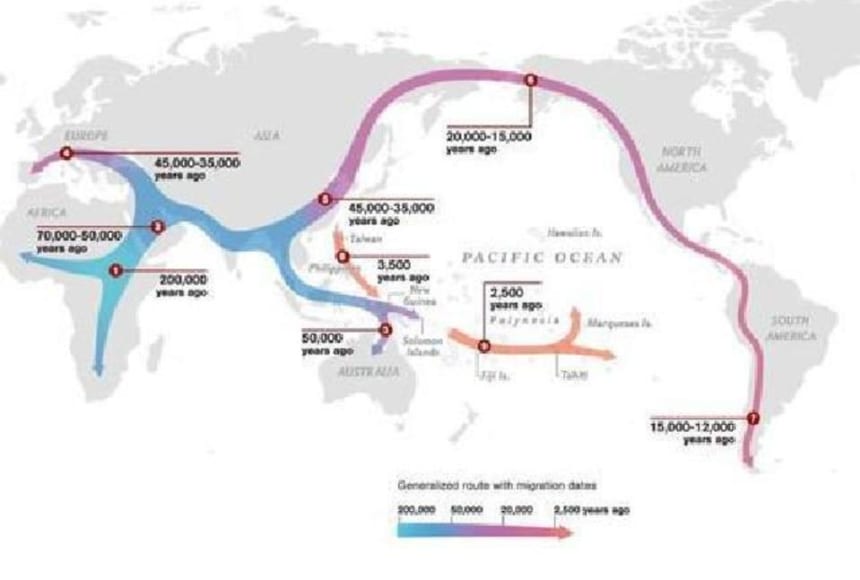
| Paleo-indians spread across the American continents between 25-14,000 years ago. The period before 8000 BCE saw most populations living as hunter gatherers as we saw in Paleolithic Eurasia, for example. |
During the Archaic period, 8000-1000 BCE, identifiable settlements began to appear, contemporaneous with Narmer's unification of Upper and Lower Egypt. In South America, the first settled society is called Norte Chico, a civilization that depended mostly on fishing and some crop domestication. After their decline, a long succession of settled societies lived in the Andes region, the most famous today were the Incas.
In Mesoamerica, the Olmec built the first civilization about 1600 BCE, and appears to be a parent culture to the succeeding civilizations in Mesoamerica. (Where is Mesoamerica? why is determining a parent culture significant?) Mesoamericans domesticated maize by about 7500 BCE; by 2700 BCE most populations seem to have settled into towns, by about 1300 BCE, most populations seem to have settled and show traits identified as characteristic of Olmec: stone monuments, including the giant heads readily identifyable today as iconic of the civilization, ceremonial complexes with palaces, pyramids, aquaducts, and including clay and jade figures of animals (especially jaguars) and humans.
Tlatilco figurines (early pre-classical period, 1200-400 BCE) preceded the Olmec figures, and created many, extremely varied ceramic figures that represented many aspects of daily life (and death). These do not seem to carry forward stylistically or in terms of content to future civilizations (but they are pretty irresistible to this Art Historian as indicative. of lives lived in community and connection with other people, with ancestors, and with animals). Modern Mexico city sits on top of this extensive farming community, making extensive excavation very difficult.
Quick summary of traits shared by Mesoamerican settlements in present-day Mexico, and Woodland settlements and Mississipian culturex in North America, from Wikipedia: "Cities of the Aztecs, Mayas, and Incas were as large and organized as the largest in the Old World, with an estimated population of 200,000 to 350,000 in Tenochtitlan, the capital of the Aztec Empire. The market established in the city was said to have been the largest ever seen by the conquistadors when they arrived. The capital of the Cahokians, Cahokia, located near modern East St. Louis, Illinois, may have reached a population of over 20,000. At its peak, between the 12th and 13th centuries, Cahokia may have been the most populous city in North America. Monk's Mound, the major ceremonial center of Cahokia, remains the largest earthen construction of the prehistoric New World."
The Classical Period followed, from about 600 BCE- 1533 CE, featuring names that may be much more familiar to students in the Americas: Maya, Pueblo, Aztec, Inca, Iroquois

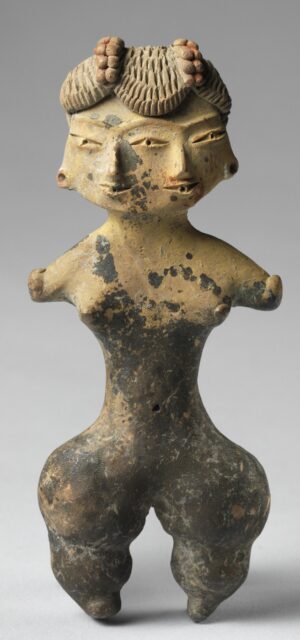 |
| Double-faced female figurine, c. 1200–900 B.C.E. (early formative period, Tlatilco), ceramic with traces of pigment, 9.5 cm high |
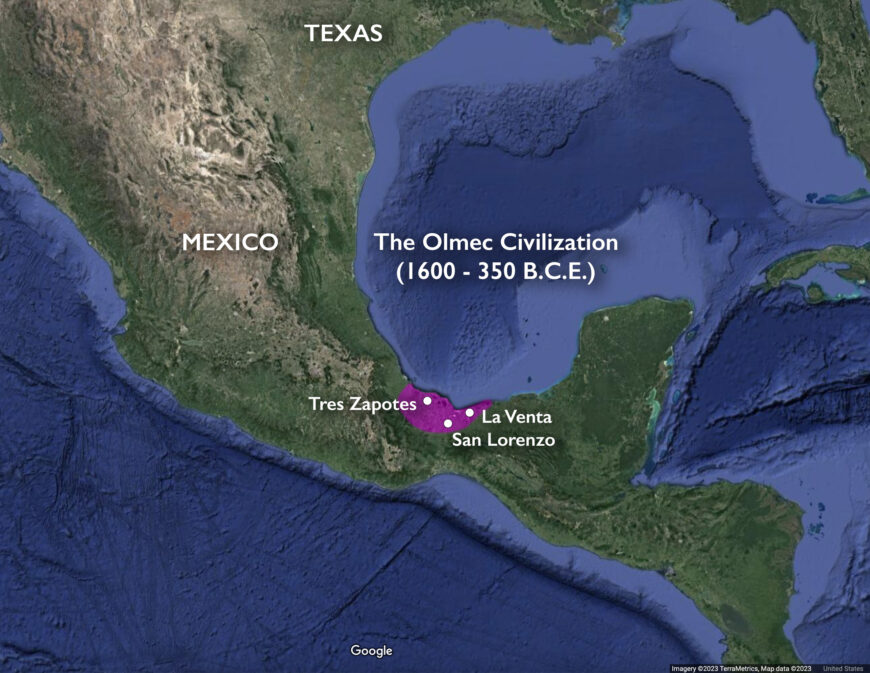 |
| 16 heads, ranging from 1.47 m to 3.4 m in height and weighing between 6 and 25.3 tons, have been recovered from the three main Olmec archaeological sites: San Lorenzo, La Venta, and Tres Zapotes. |
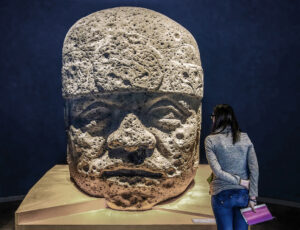 |
| San Lorenzo Colossal Head 2, before 900 B.C.E. (Olmec), basalt, 2.69 x 1.83 x 1.05 m |
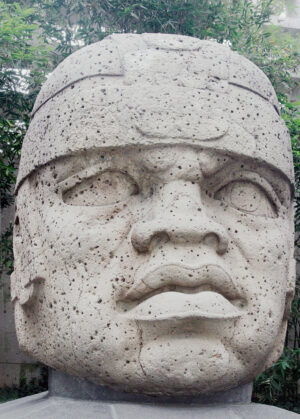 |
| San Lorenzo Colossal Head 1, before 900 B.C.E. (Olmec), basalt, 2.84 x 2.11 m |
Teotihuacan, in present-day Mexico, was the first large city in the Americas,
occupied by 125-200,000 people by the 500's CE. Note the difficulty of naming! (named in Nahuatl by the Aztec long after their demise) A great mystery to us today, in part because no their hieroglyphic language hasn't been translated, and because there is no evidence of a cult of personality as with the Olmec, very little record of individual people....but incredible record of organization, sophistication of technology, record of religion and warfare, but no narrative clarity has emerged. Excavations are ongoing.
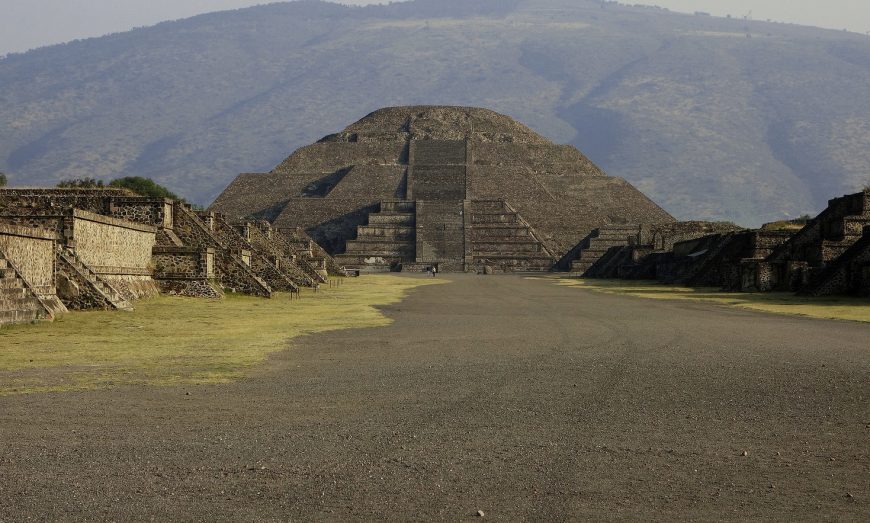 |
Pyramid of the Moon seen from the Avenue of the Dead with Cerro Gordo in the distance, Teotihuacan, Mexico (photo: Steven Zucker, CC BY-NC-SA 2.0) |
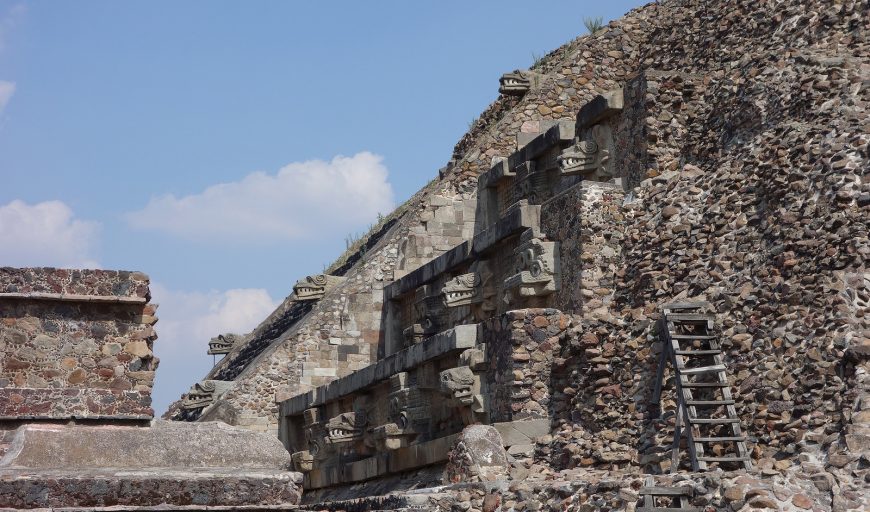 |
Pyramid the Temple of Quetzalcoatl (feathered serpent), Teotihuacan, Mexico 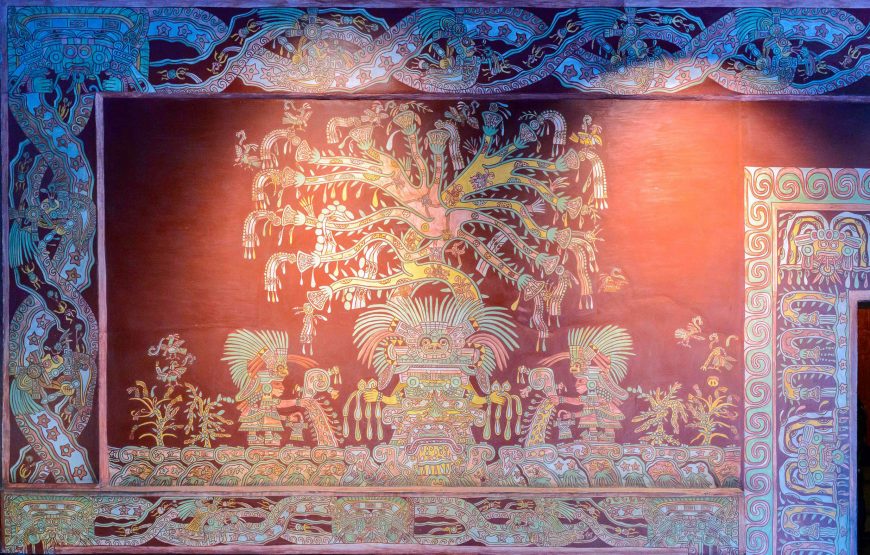 | Agustín Villagra, reconstruction of mural from Tepantitla in Teotihuacan in the National Museum of Anthropology in Mexico City (photo: Steven Zucker
In present-day Colombia, "Muisca, Quimbaya, Calima, Tairona, Tolima and Zenú chiefdoms in ancient Colombia. In most instances they combine, in different degrees, gold, some natural occurring silver, and copper, a combination known as tumbaga. These metals were symbolically charged in pre-Hispanic times, being associated with the sun and the moon respectively. Their combination produced a microcosm, a balance between opposites in the rendering of each object." (Smarthistory)
|
|
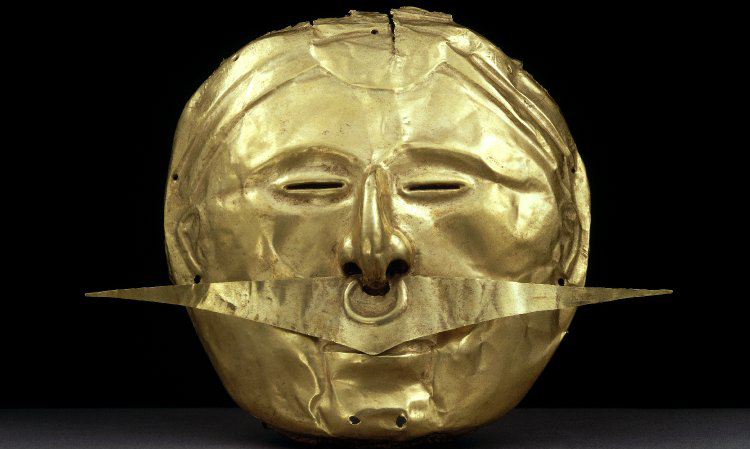 |
| Mask with Nose Ornament, c. 500 B.C.E.–1600 C.E., gold alloy, 15.5 x 18 cm. Muisca, Quimbaya, Calima, Tairona, Tolima and Zenú chiefdoms in ancient Colombia. " There’s a myth known as la leyenda de El Dorado, or the Gilded Man. In the sixteenth century, the Spanish crafted this legend around the chief of the Muisca people, who lived in the fertile basins of the eastern Andes mountains, near modern-day Bogotá. It was said that the chief was covered from head to toe in gold dust and conveyed on a raft to the middle of Lake Guatavita, cradled in the zenith of a mountain, where he’d throw gold objects into the water as offerings to the gods. Over time, the legend grew, until eventually El Dorado referred to an entire golden kingdom. In the centuries since the Spanish conquests, many lost their lives attempting to find the hidden empire and its golden treasures."Additional perspective on the art of ancient Colombia. |
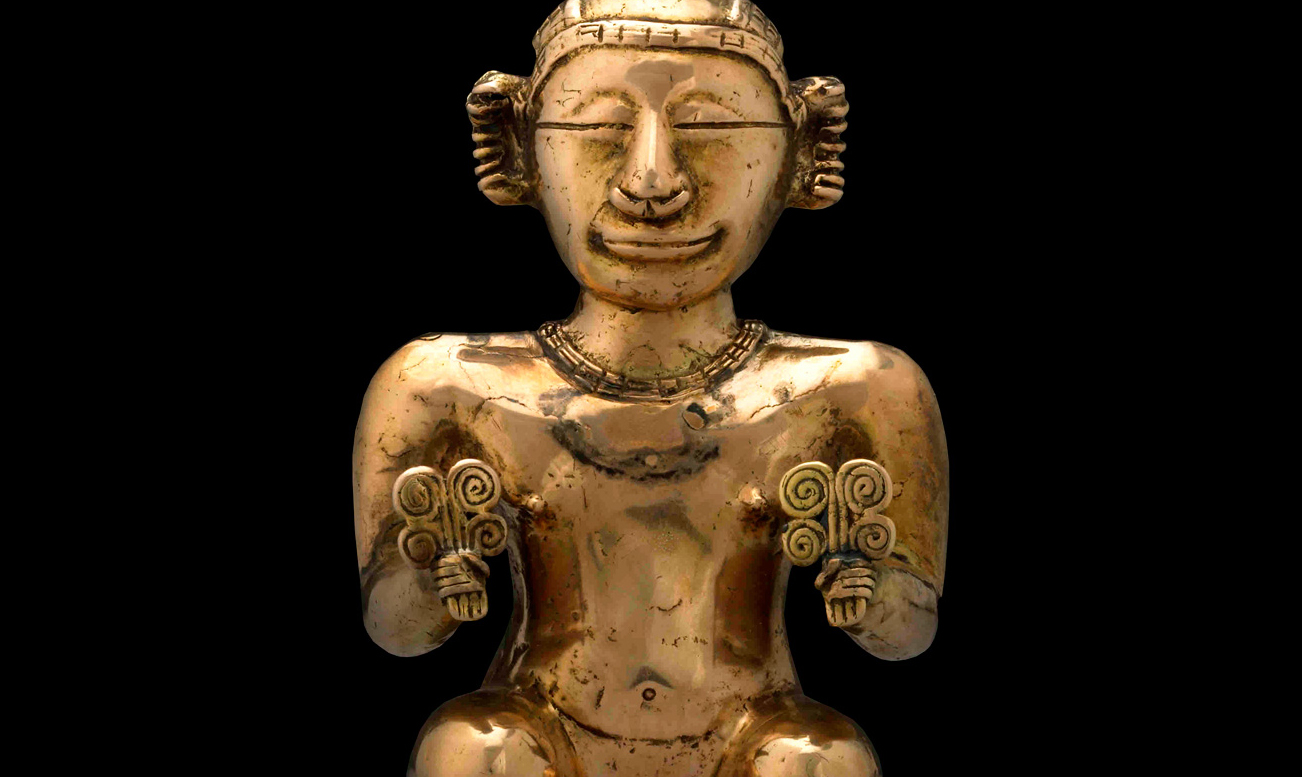 |
| Hands up close (detail), Seated Female Poporo, c. 500 B.C.E. – 700 C.E. Early Quimbaya, tumbaga (gold alloy), Colombia © The Trustees of the British Museum. This lime-flask was cast by the lost-wax method. The head, lower legs and stool were cast separately and then soldered to the body. Flasks held lime obtained from burning and grinding seashells. The alkaline lime was chewed with coca leaves to release their active stimulant and enhance clear, contemplative thinking. |
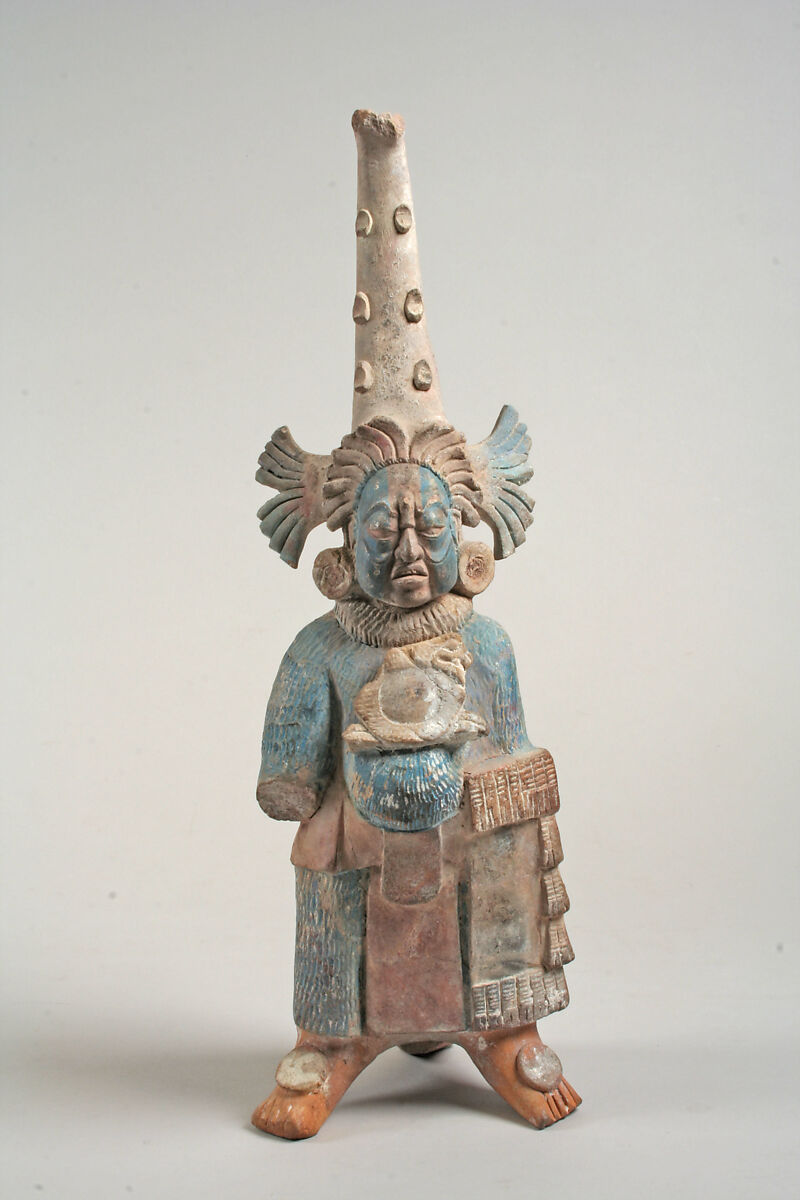 |
- Title: Figure with conical headdress and shield
- Artist: Maya artist(s)
- Date: 600–800 CE
- Geography: Mexico, Mesoamerica, Campeche, Jaina Island(?)
- Culture: Maya
- Medium: Ceramic, pigment
- Dimensions: H. 11 1/2 x W. 3 13/16 x D. 3 3/4 in. (29.3 x 9.7 x 9.5 cm)
\
Ancestral Puebloans |
|
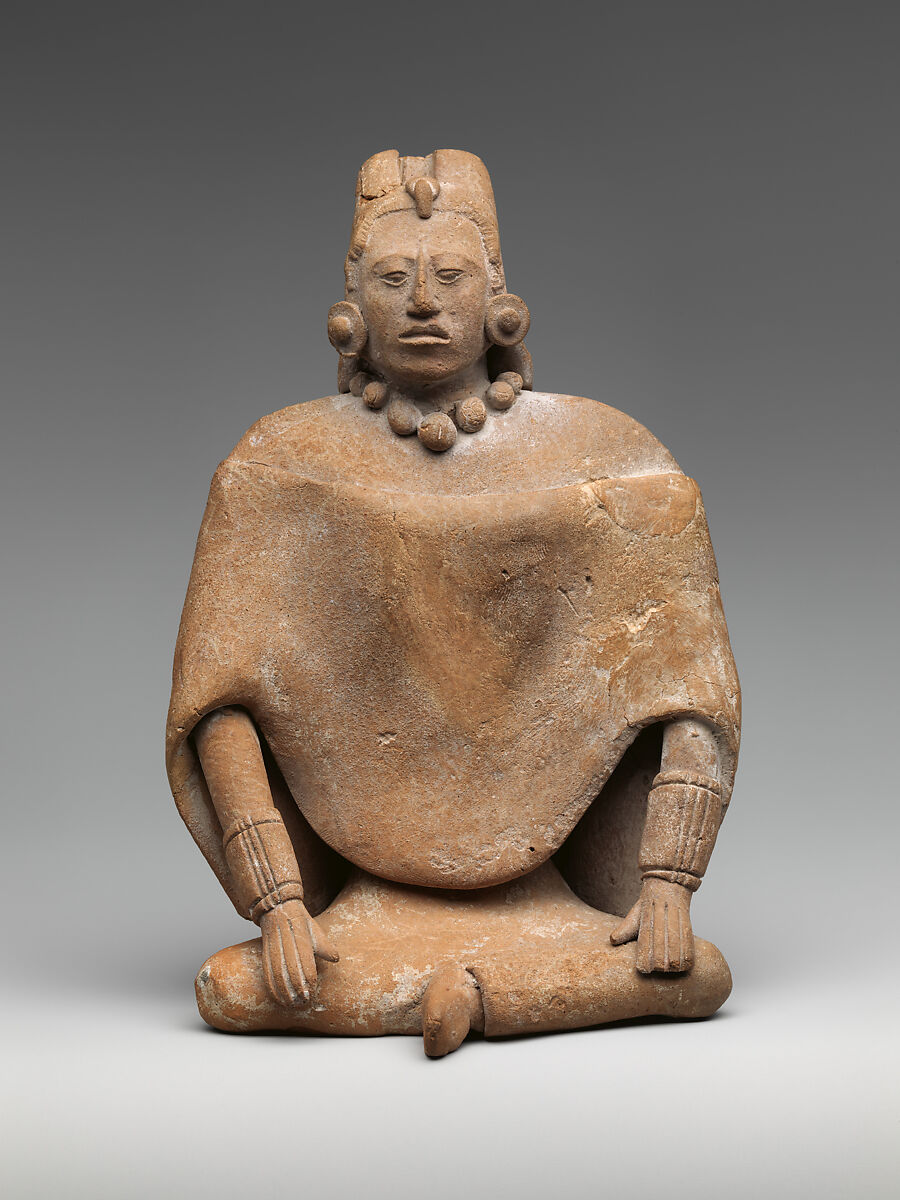
- Title: Seated female figure
- Artist: Maya artist(s)
- Date: 700–800 CE
- Geography: Mexico, Mesoamerica, Campeche, Jaina Island(?)
- Culture: Maya
- Medium: Ceramic
- Dimensions: H. 7 1/8 x W. 5 x D. 3 1/2 in. (18.2 x 12.7 x 8.9cm)
|
 |
| Rock Art from Paleo-Indians in the Amazon, about ~12000 YA |
 |
| These elaborate and well preserved Barrier Canyon style petroglyphs are located in Sego canyon in the Utah desert. They are among the best preserved pre-Columbian petroglyphs in the United States. This group is from the early Fremont Period, around 2,500 B.C. See |
 |
Cliff Palace is the largest cliff dwelling in Mesa Verde National Park. The area was inhabited from about 7500 bce until the ancestral Puebloan culture emerged about 750 ce. by late 12th c. ce, the culture was suffering from hunger caused by drought and warfare |
Ancestral Puebloan
 |
People Who Live in a Circle. They Excavate Their Past and Rebuild It into Their Present. Their Dwelling Functions as a Personal and Cosmological Clock, Seasonal, Harmonic, Obsessive.,1972. Collection MoMA, New York
|




No comments:
Post a Comment