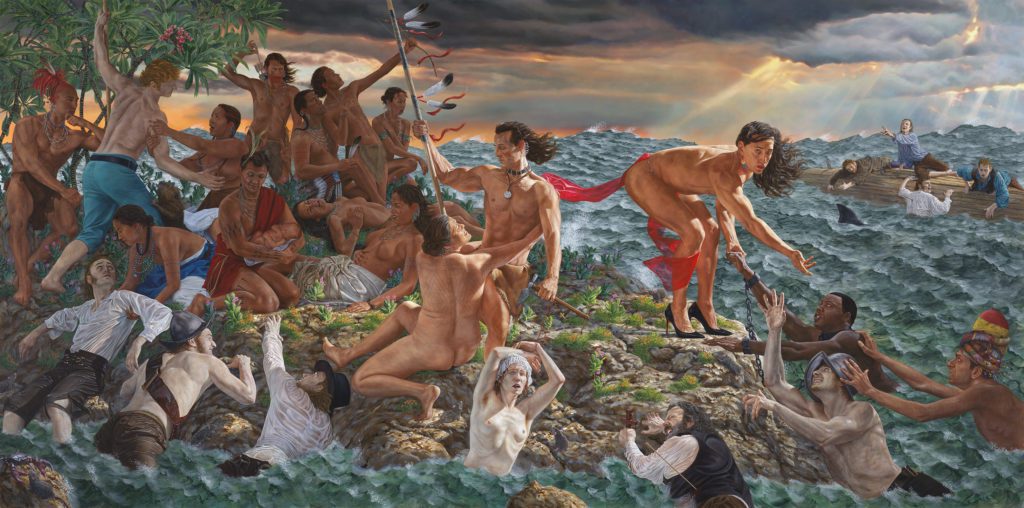
Kent Monkman (First Nations, Cree, born Saint Marys, Ontario b. 1965), mistikôsiwak (Wooden Boat People): Welcoming the Newcomers , 2019 More info, source
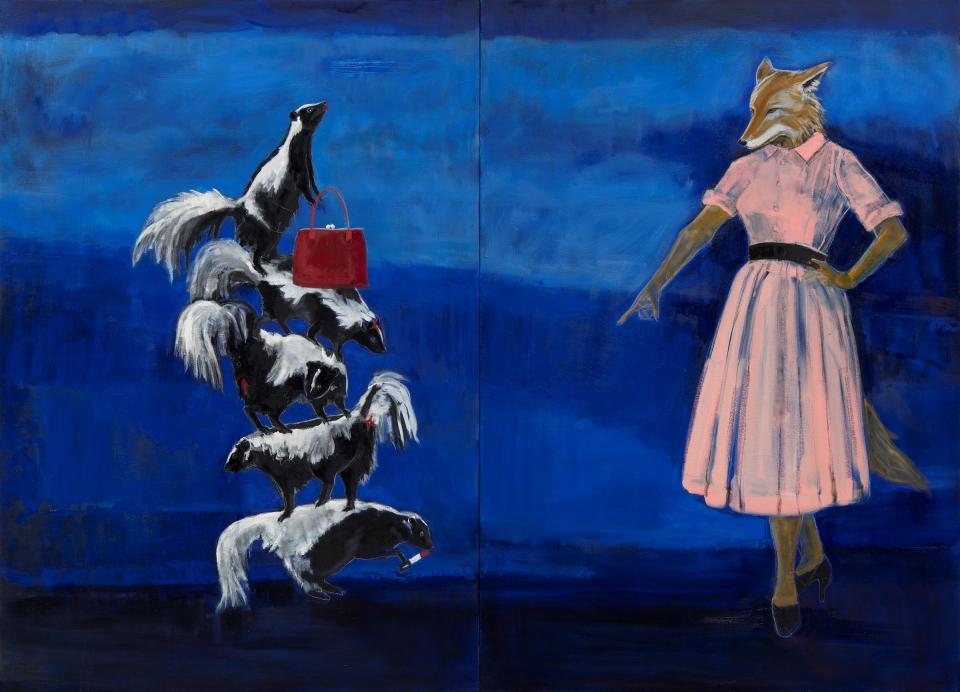
Julie Buffalohead, A little Medicine and Magic, 2018
Julie Buffalohead, Why I hate Bras, 2018\

Jaune Quick-to-See Smith, Trade (Gifts for Trading Land with White People), 1992, oil paint and mixed media, collage, objects, canvas, 152.4 x 431.8 cm (Chrysler Museum of Art, Norfolk)
As a response to the 500th anniversary of Christopher Columbus’ arrival in North America in 1992, the artist Jaune Quick-to-See Smith, from the Confederated Salish and Kootenai Tribes of the Flathead Indian Nation, created a large mixed-media canvas called Trade (Gifts for Trading Land with White People). Trade, part of the series “The Quincentenary Non-Celebration,” illustrates historical and contemporary inequities between Native Americans and the United States government.
Trade references the role of trade goods in allegorical stories like the acquisition of the island of Manhattan by Dutch colonists in 1626 from unnamed Native Americans in exchange for goods worth 60 guilders or $24.00. Though more apocryphal than true, this story has become part of American lore, suggesting that Native Americans had been lured off their lands by inexpensive trade goods. The fundamental misunderstanding between the Native and non-Native worlds—especially the notion of private ownership of land—underlies Trade. Smith stated that if Trade could speak, it might say:
Why won’t you consider trading the land we handed over to you for these silly trinkets that so honor us? Sound like a bad deal? Well, that’s the deal you gave us.
Olga de Amaral, Estella (Wake Grouping), 2018, linen, gesso, acrylic, and gold leaf; each element 61-76 inches high. Source-- More info about Olga de Amaral here at Art in America via Artnews (This is also a useful example of art writing and 'reading' abstraction)




No comments:
Post a Comment